


Author of materials about St. Petersburg, travel, tours and city routes.

Historian and guide in St. Petersburg, Peterhof, Tsarskoye Selo and Vyborg.
The Great Gatchina Palace is the main attraction of Gatchina and one of the most unusual imperial residences in the surroundings of Petersburg. It was built in 1766–1781 according to the design of Antonio Rinaldi for one of the main favorites of Catherine II.
Today, inside the Great Gatchina Palace, more than 50 rooms with restored interiors and museum exhibitions are open. We tell you what the Gatchina Palace looks like outside and inside, which halls deserve special attention, how much tickets cost and how to get there from Saint Petersburg. And you can see everything with your own eyes and hear about the secrets of the residence on a tour to Gatchina with Leningrad-Tour.
Gatchina Palace from the outside
When you first approach the Great Gatchina Palace, the familiar images of elegant St. Petersburg residences are instantly erased from your memory. Before you stands a true medieval castle, austere and majestic, the likes of which you will not find anywhere else in the suburbs of St. Petersburg.
Southern Facade
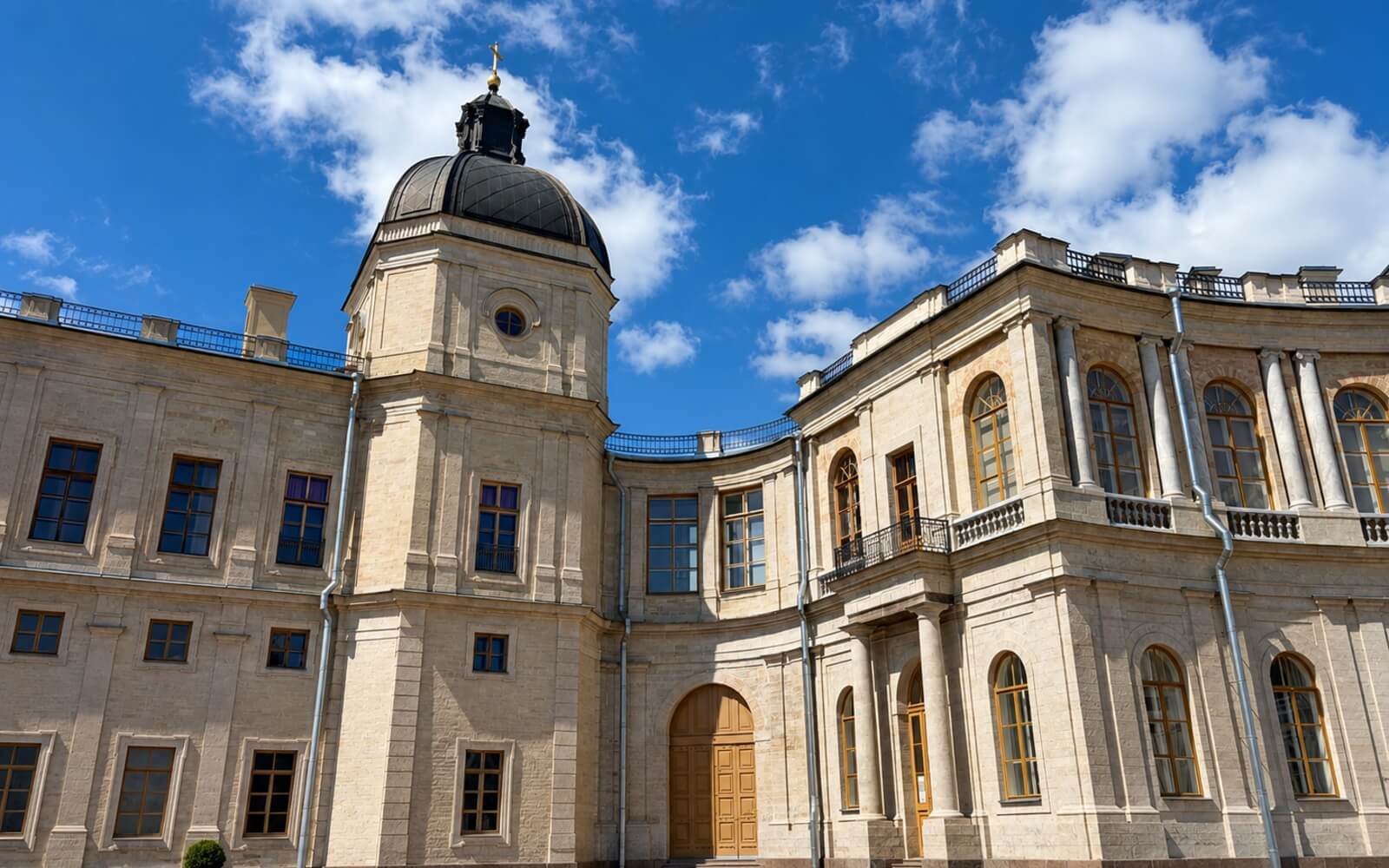
The southern facade, clad in the austere Pudost stone, greets you as a mighty citadel with two 30-meter pentagonal towers: the Clock Tower, which has preserved Orlov's chimes, and the Signal Tower, which offers the best observation deck. The stern bastions and 16 bronze "unicorn" cannons finally turn the palace into an impregnable knight's castle.
Northern Facade
But as soon as you walk around the palace and come out to the northern facade, the austerity gives way to the romance of a hunting castle or an Italian palazzo. Here the building literally grows out of the hill above the mirror-like surface of the Silver Lake. It was onto this side, toward the cozy Private Garden, closed off from prying eyes, that the windows of the private chambers of Emperor Paul I looked out.
Interiors and halls of the Gatchina Palace
The Gatchina Palace has more than 50 rooms open with restored interiors and museum exhibitions, but the state rooms, where members of the imperial family once lived, are especially impressive.
Antechamber
Once in this hall, to the sounds of flutes, the imperial guard changed and guests languished in anticipation of an invitation to Paul I's table. In the Antechamber, the eye involuntarily catches on the surviving white Siberian marble vase, which, unlike many other objects, never left its historical place. Although the luxurious fireplace and the ceiling panel "Faith and Love" are imported 18th-century masterpieces that replaced wartime losses, the walnut doors and pinkish architraves themselves are absolutely authentic and still remember the palace's first owner, Count Orlov.
Marble Dining Room
Following the austere reception room, the light-filled Marble Dining Room opens up, appearing like a theatrical set for an ancient myth thanks to its sixteen majestic Carrara marble columns. Be sure to find the elegant statue of Eros – the heart of the hall, where Paul I held formal dinners, separating the bustling buffet area from the guests with a light marble balustrade.
Despite the fact that the fire of war did not spare the wooden decoration, today we see a masterfully recreated interior, where the Italian marble damaged by flames has regained its former beauty.
Upper Throne Room
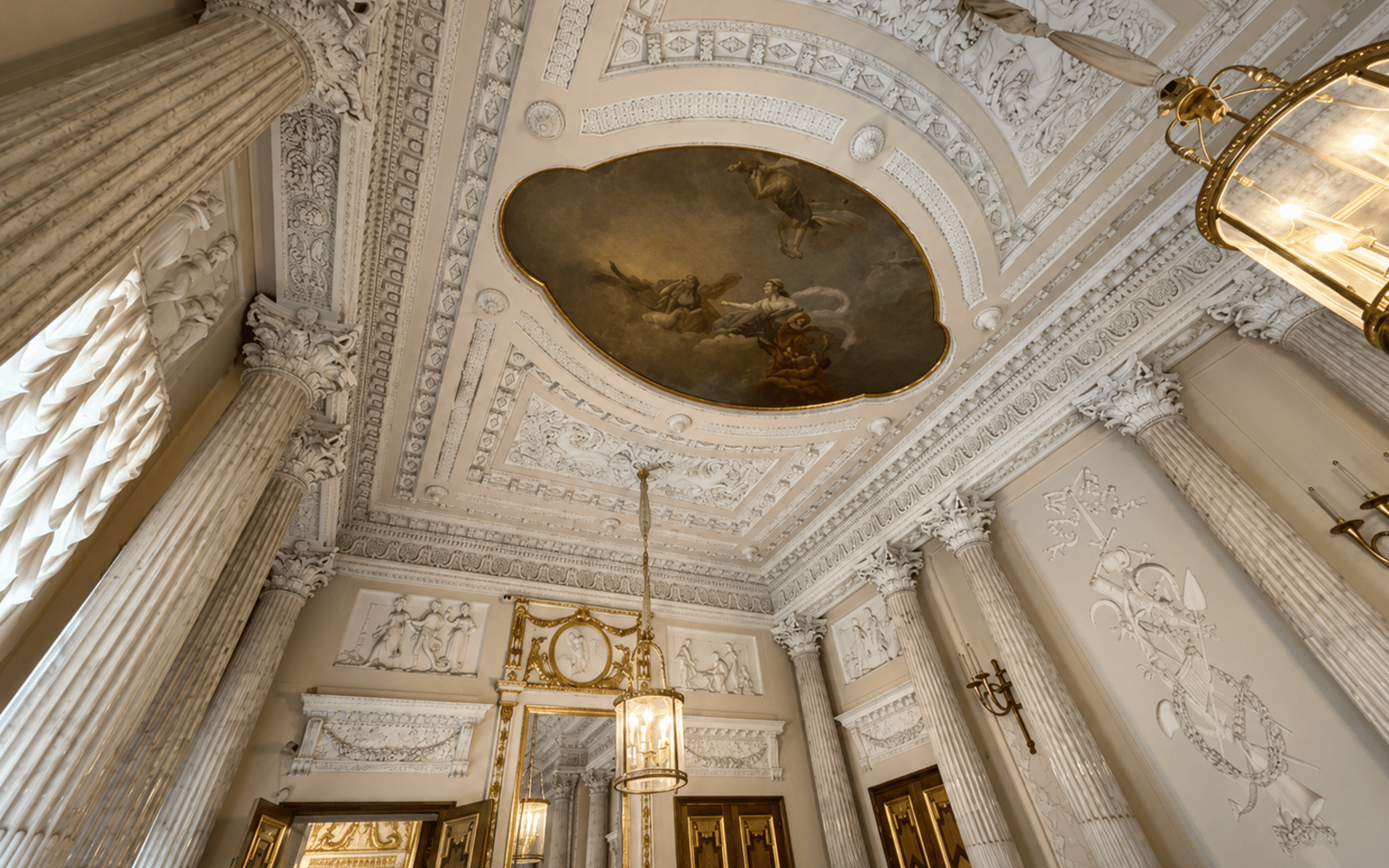
Next on the route is the Upper Throne Room of Paul I, which, with its modest 50 square meters of area, amazes with an abundance of gilding and unique French tapestries – a personal gift from Louis XVI to the future emperor.
In the center of the hall stands a throne chair, made after the model of the throne of Anna Ioannovna, and underfoot shines a parquet floor recreated from old drawings using the rarest types of wood: rosewood, amaranth, and apple. It was here that Paul I received foreign ambassadors.
White Hall
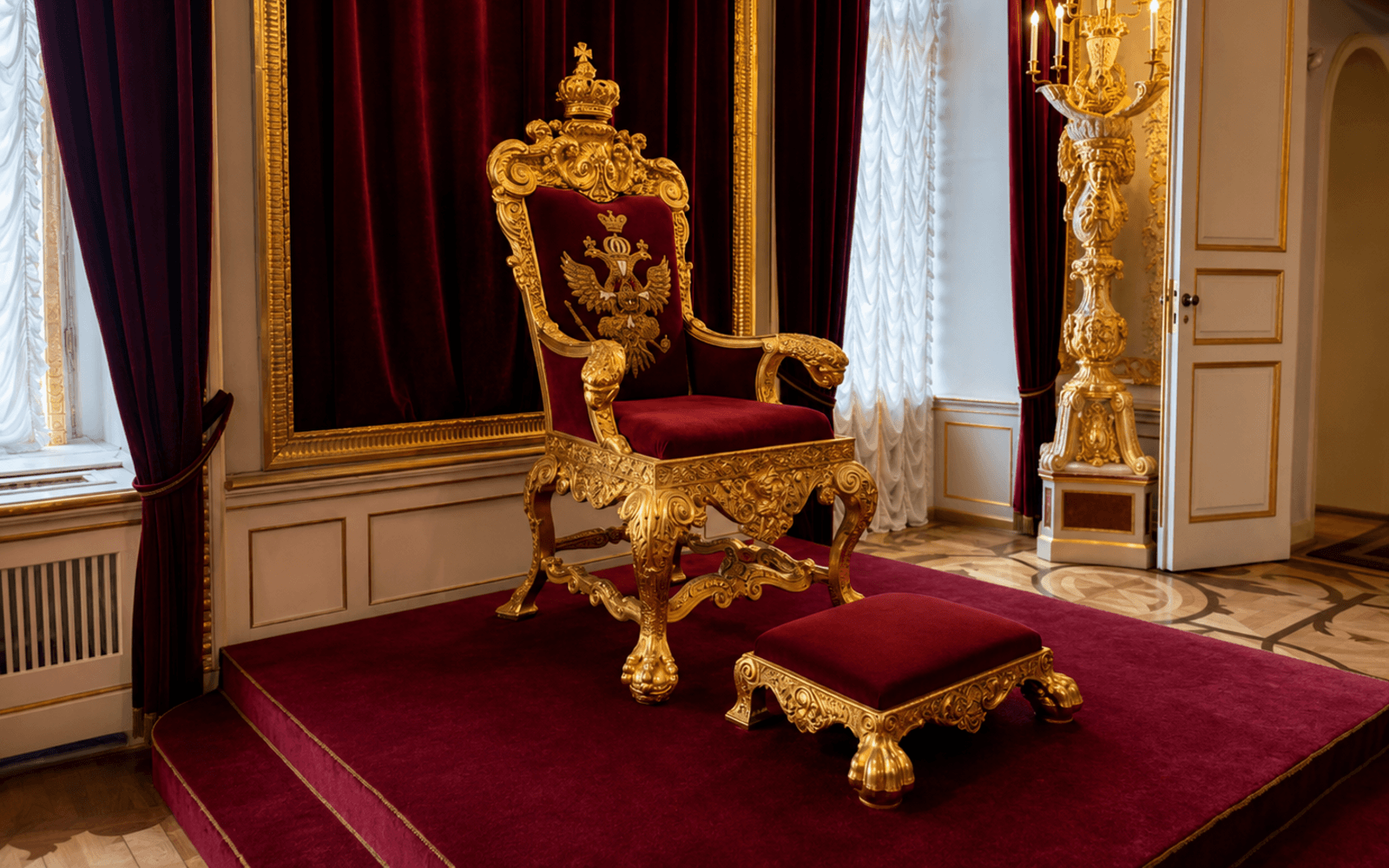
And in the White Hall, even under Count Orlov and Paul I, the most lavish balls thundered, as it is the largest hall in the palace, with an area of 250 m². From here, guests could step directly onto the terrace through tall arched door-windows to breathe in the fresh air and admire the parade on the square.
Here reigns a noble restraint of pastel tones and white stucco, where among the elegant flowers you can find Rinaldi's ironic "signatures" in the form of ears of grain or even reliefs with huge lobsters
Empress Maria Feodorovna's Throne Room
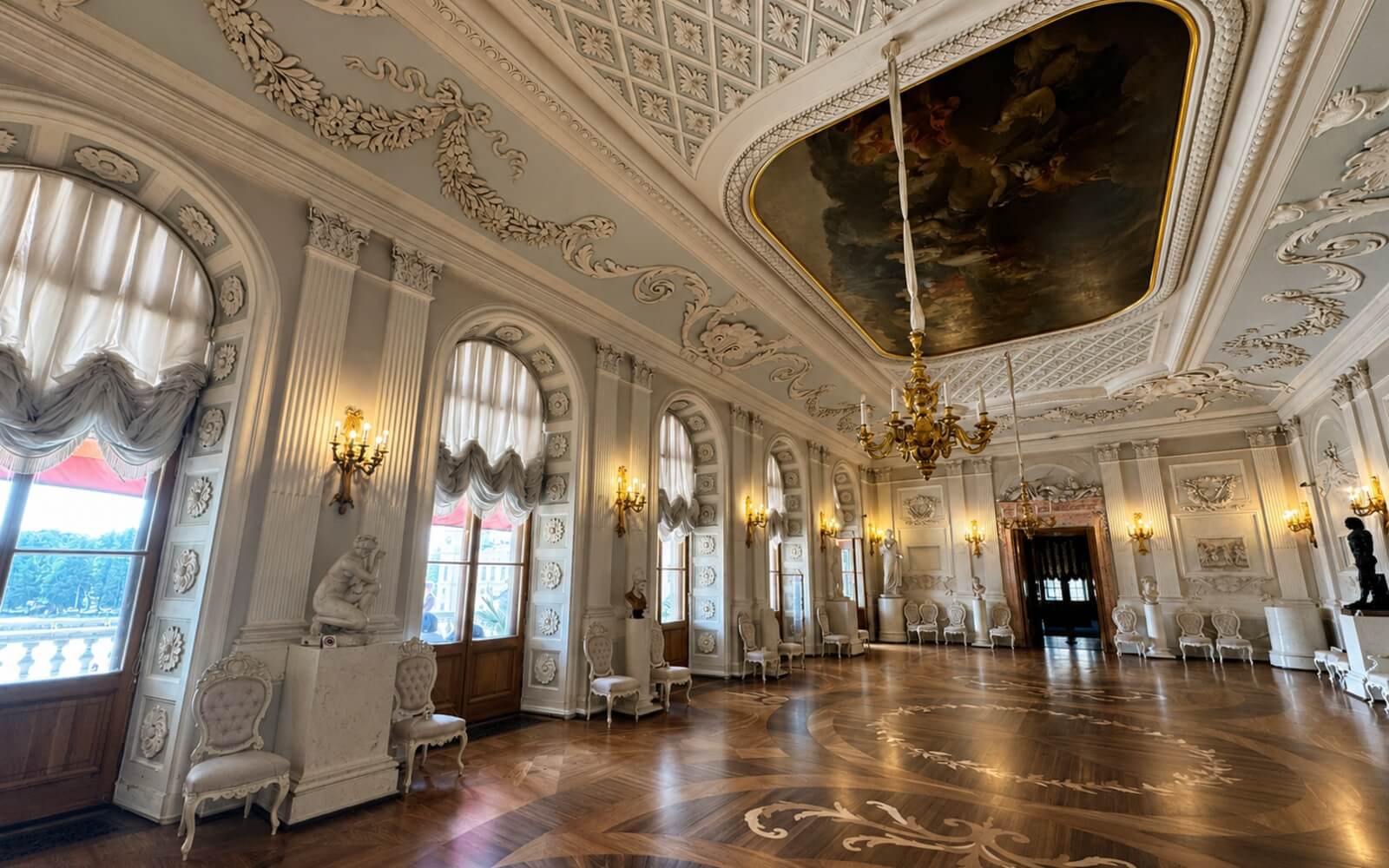
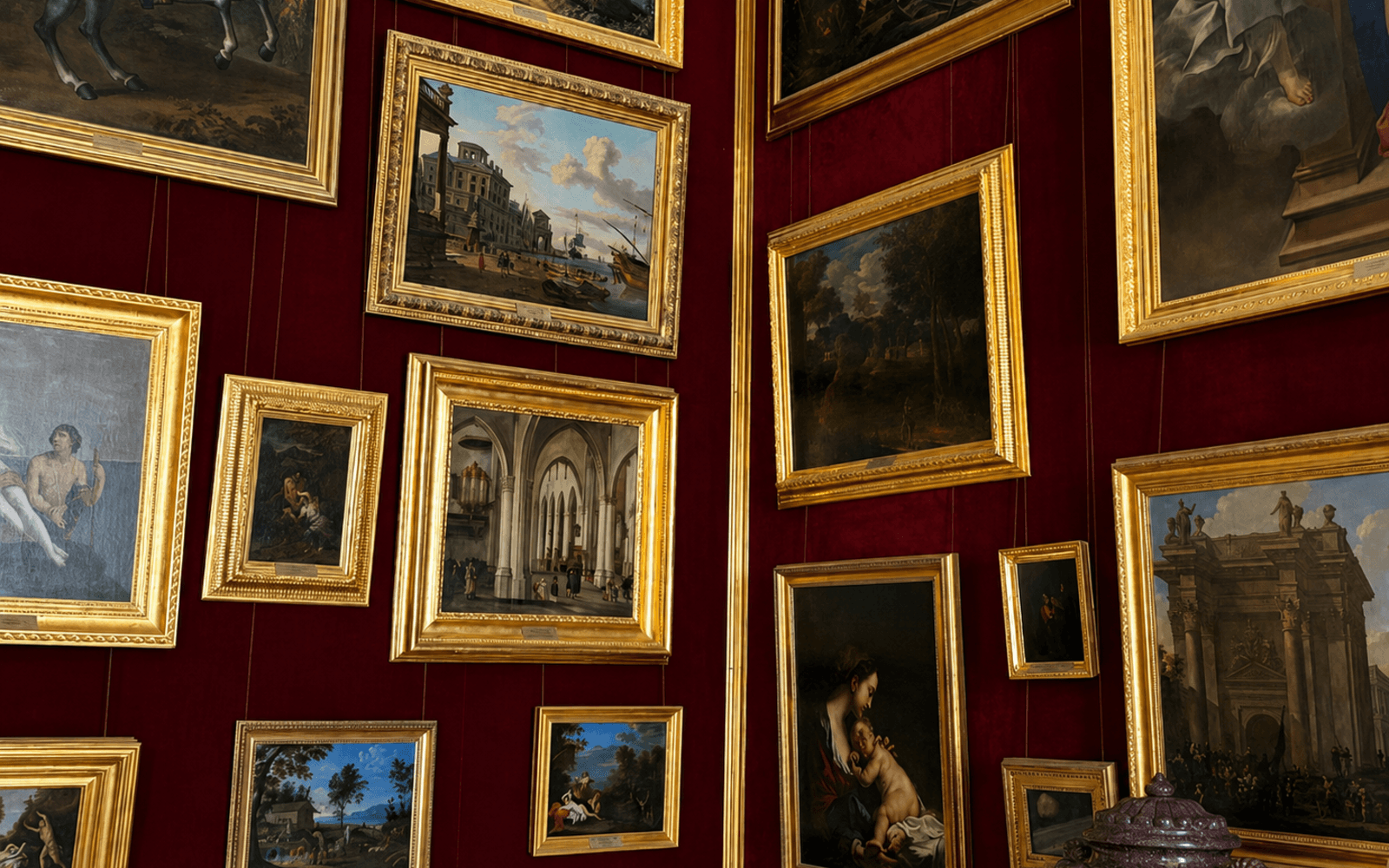
Moving on into Maria Feodorovna's Throne Room, where the empress received foreign ambassadors, you find yourself in a true "kingdom of painting": the walls here are hung from floor to ceiling with 59 canvases by European masters, among which it is impossible to tear your eyes away from the masterpieces "The Judgment of King Solomon" and "Diana at the Hunt".
The interior of this hall, which has served both as Count Orlov's Chinese Room and as a rich picture gallery, dazzles with the golden embroidery of the canopy and the flawless hanging of the paintings, which today occupy their strictly historical places.
State Bedchamber
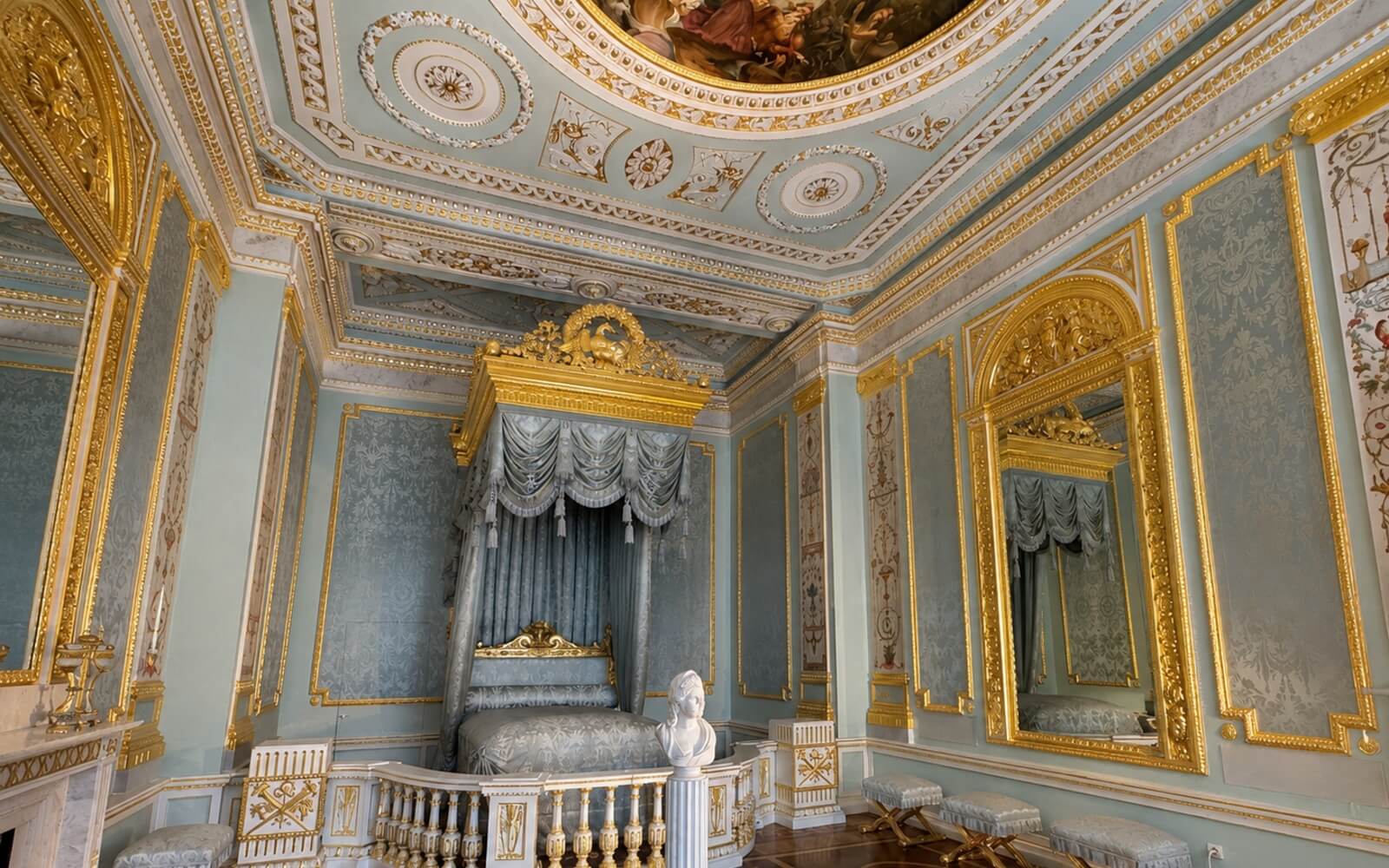
Walking further, you find yourself in the State Bedchamber, which served for ceremonial receptions, astonishing guests with its combination of sky-blue Lyon silk.
And, by the way, this hall has a secret! Mirrors placed opposite each other create a magical effect of infinite space, in which a hidden door is concealed leading to a spiral staircase that goes straight to Paul I's private chambers.
The underground passage and the Echo Grotto
Beneath the palace's state halls lies a 130-meter underground passage lined with limestone. Built under Count Orlov as a wine cellar, this dim tunnel leads from the palace cellars straight to the Silver Lake. Today grotto seems like a portal to the past, where around every turn one senses the shadow of the emperor.
And it is here that the nymph Echo herself begins to flirt with you. She eagerly catches your every word and then answers from somewhere. Ask her: "Who ruled here?" – and she will obediently breathe: "Paul!", and to the question "Who defeated the French?" – she will answer: "Kutuzov!".
But there is no need to fear her; instead, set off on a tour of the Gatchina Palace, to ask the question that interests you and get an answer. Maybe you will even see the wandering ghost of Paul I.
Where the Great Gatchina Palace is located and how to get there
The Great Gatchina Palace is located at: Gatchina, Krasnoarmeysky Prospekt, 1, approximately 35 kilometers from Saint Petersburg.
Address: Gatchina, Krasnoarmeysky Prospekt, 1.
Coordinates: 59.56333° north latitude, 30.1075° east longitude; 59° 34' 48.0" north latitude, 30° 6' 27.0" east longitude.
Open in Yandex Maps →The most convenient way is to take a train from Baltiysky railway station to Gatchina-Baltiyskaya station, which is located closest to the palace; Gatchina-Varshavskaya station is worth choosing if you want to start your walk from Priory Park and then proceed to the imperial residence.
Bus No. 431 and minibuses No. 18 and 18A depart to Gatchina from the Moskovskaya metro station, and by car you need to drive along Kievskoye Highway. The simplest and most comfortable option is a tour to Gatchina from St. Petersburg departing from the city center on a comfortable bus, where entrance tickets are already included in the price.
Opening hours and tickets
Information updated on July 20, 2026: in summer the Great Gatchina Palace is open daily from 10:00 to 19:00, ticket offices and entrance operate until 18:00, and the nearest sanitary days are scheduled for August 3 and 4.
Tickets to the Great Gatchina Palace cost 700 rubles for adults, 400 rubles for students and pensioners, a family ticket is 1600 rubles. Opening hours and admission prices vary depending on the season, so before your trip it is worth checking the current information on the official website of the Gatchina Museum-Reserve
Frequently asked questions about the Great Gatchina Palace
When was the Great Gatchina Palace built?
The Great Gatchina Palace was built in 1766–1781 according to the design of Antonio Rinaldi for one of the main favorites of Catherine II.
What to see inside the Great Gatchina Palace?
Inside, more than 50 rooms are open with restored interiors and museum exhibitions. The Antechamber, the Marble Dining Room, the Upper Throne Room of Paul I, the White Hall, the Throne Room of Maria Feodorovna and the State Bedchamber deserve special attention.
Where is the Great Gatchina Palace located?
The Great Gatchina Palace is located at: Gatchina, Krasnoarmeysky Prospekt, 1, approximately 35 kilometers from Saint Petersburg.
What is the most convenient way to get to the Great Gatchina Palace from St. Petersburg?
The most convenient way is to take a train from Baltiysky railway station to Gatchina-Baltiyskaya station, which is located closest to the palace. Also, bus No. 431 and minibuses No. 18 and 18A depart from the Moskovskaya metro station.
How much do tickets to the Great Gatchina Palace cost?
According to information updated on July 20, 2026, tickets cost 700 rubles for adults, 400 rubles for students and pensioners, a family ticket is 1600 rubles. Before your trip, it is worth checking the current price on the museum's official website.
What is interesting about the underground passage and the Echo Grotto?
A 130-meter underground passage leads from the palace cellars to the Silver Lake. In the Echo Grotto, unusual acoustics pick up visitors' words and return them as a distinct answer.
Tour to the Gatchina Palace
Gatchina Palace is a place of contrasts: from the roar of parades on the square to the mysterious whisper in the dungeons, and it is this duality that makes you fall in love with it forever.








