Writes about St. Petersburg, its history, sights, museums and routes.
Accredited guide for St. Petersburg, its suburbs and excursions for families with children.
Saint Petersburg is always happy to give its guests unforgettable impressions, and in its very heart, on Nevsky Prospekt, stands a structure that evokes genuine delight and a desire to return to it again and again. Kazan Cathedral is a true architectural masterpiece, embodying in stone the grandeur of Russian history and the spiritual power of the people. By the way, we recommend not only walking around it outside and visiting it inside, but also having breakfast opposite in a cafe on the second floor in the Singer House with a view of Kazan Cathedral.
This place naturally fits into the life of the city in any season. Here young couples and older people stroll, friends meet, dates are arranged, tourists and residents of Saint Petersburg come.
In front of the cathedral is Kazan Square. In the center there is a fountain, where lovers often stop. It is believed that if you throw a coin into the water and make a wish for long and happy love, it will surely come true.
The beginning of the history of Kazan Cathedral
The history of the cathedral is filled with the inspiration of Emperor Paul I, who, after traveling through Europe, wished to adorn the capital with a church comparable in grandeur to St. Peter's Basilica in Rome. The idea was to create a national shrine worthy of housing the miraculous Kazan Icon of the Mother of God, patroness of the Romanov house. This became the reason why the future cathedral received the name Kazan.
Previously, on the site of Kazan Cathedral stood the Church of the Nativity of the Theotokos.
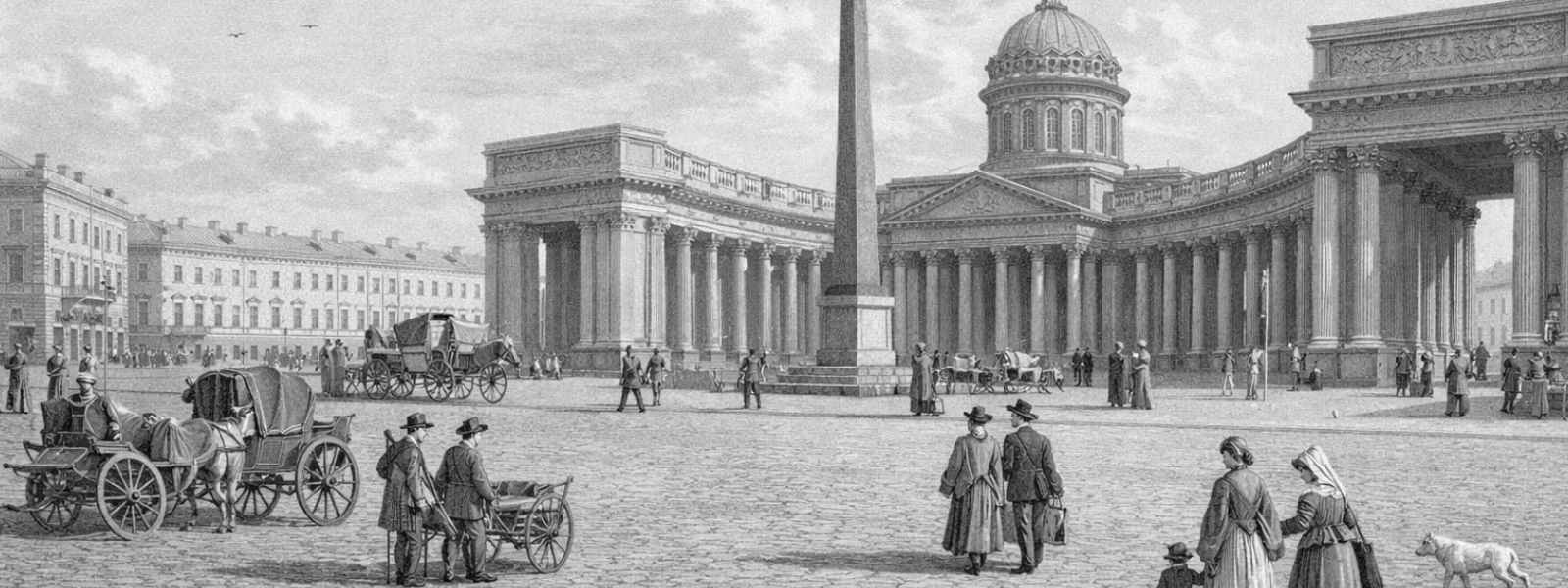
The implementation was entrusted to Andrey Nikiforovich Voronikhin. His fate is admirable: born into the family of serfs of Count Stroganov, thanks to his rare talent and the support of a patron, he received an excellent education in Russia and Europe. Voronikhin became the first to apply new principles of urban planning, turning the cathedral into an organizing center of a vast urban space.
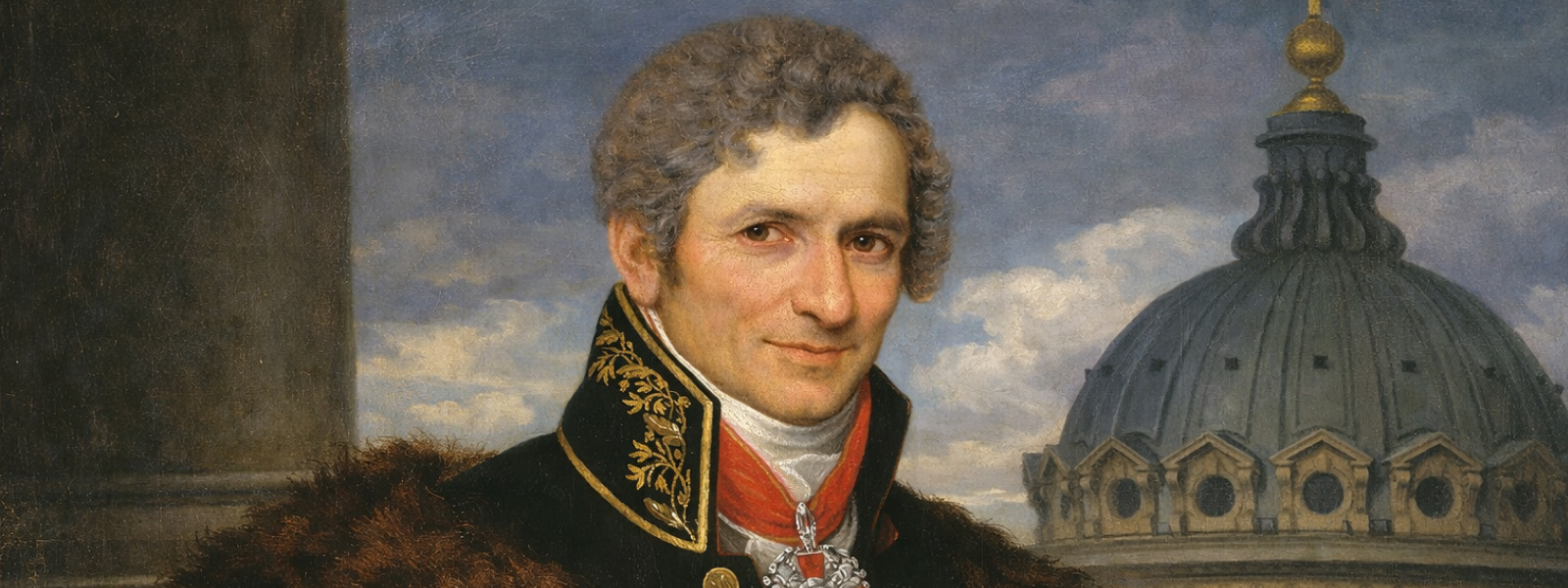
Construction, which began in 1801 under Emperor Alexander I, became the life's work of Count Alexander Stroganov, who headed the board of trustees and directed all his resources to the creation of this monument.
Architectural symbols and features of Kazan Cathedral
Looking at the cathedral from a bird's-eye view, one can see that the building together with the colonnade forms the outlines of the letters “I” and “Х”, symbolizing the name of Jesus Christ in Church Slavonic. Because of wars, there was not enough money for the second colonnade, and only one remained.
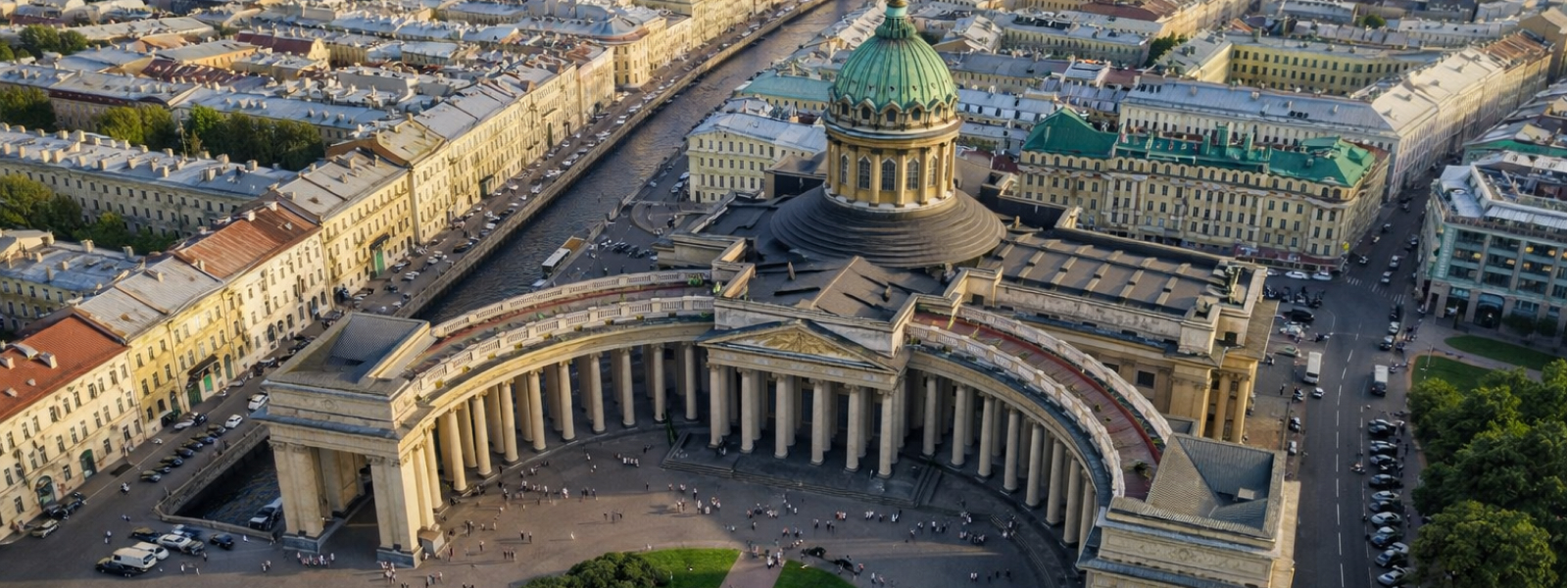
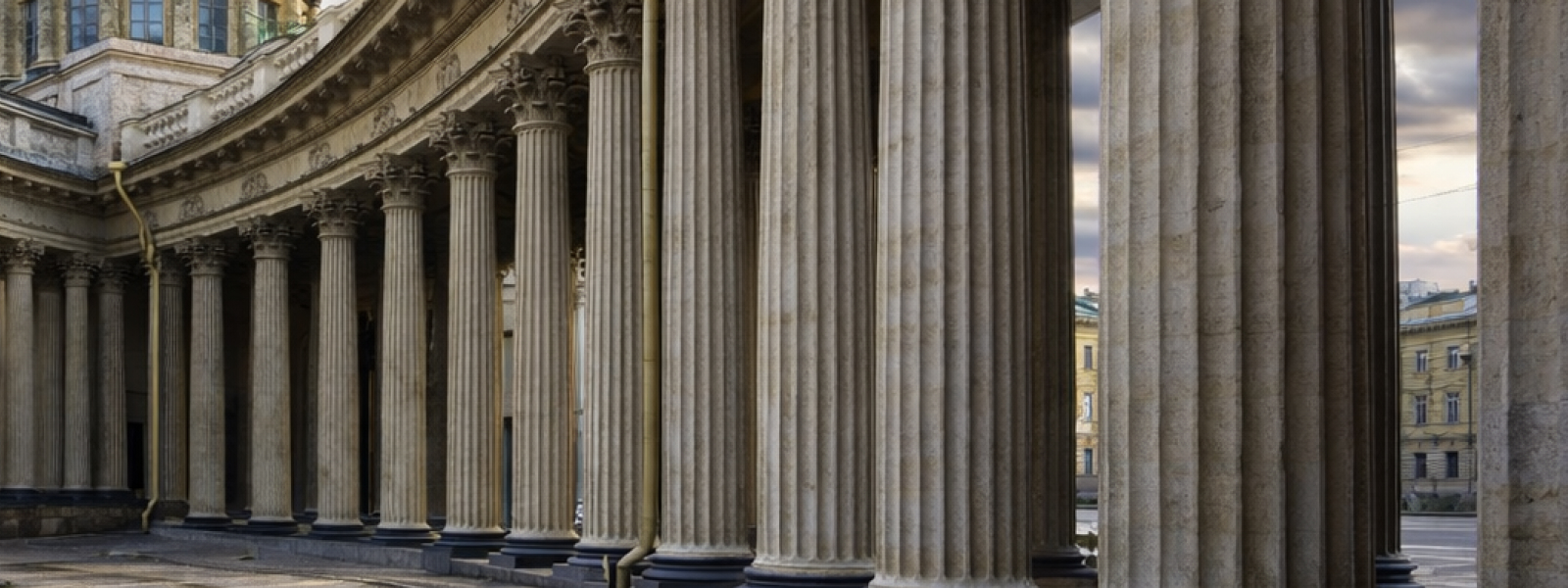
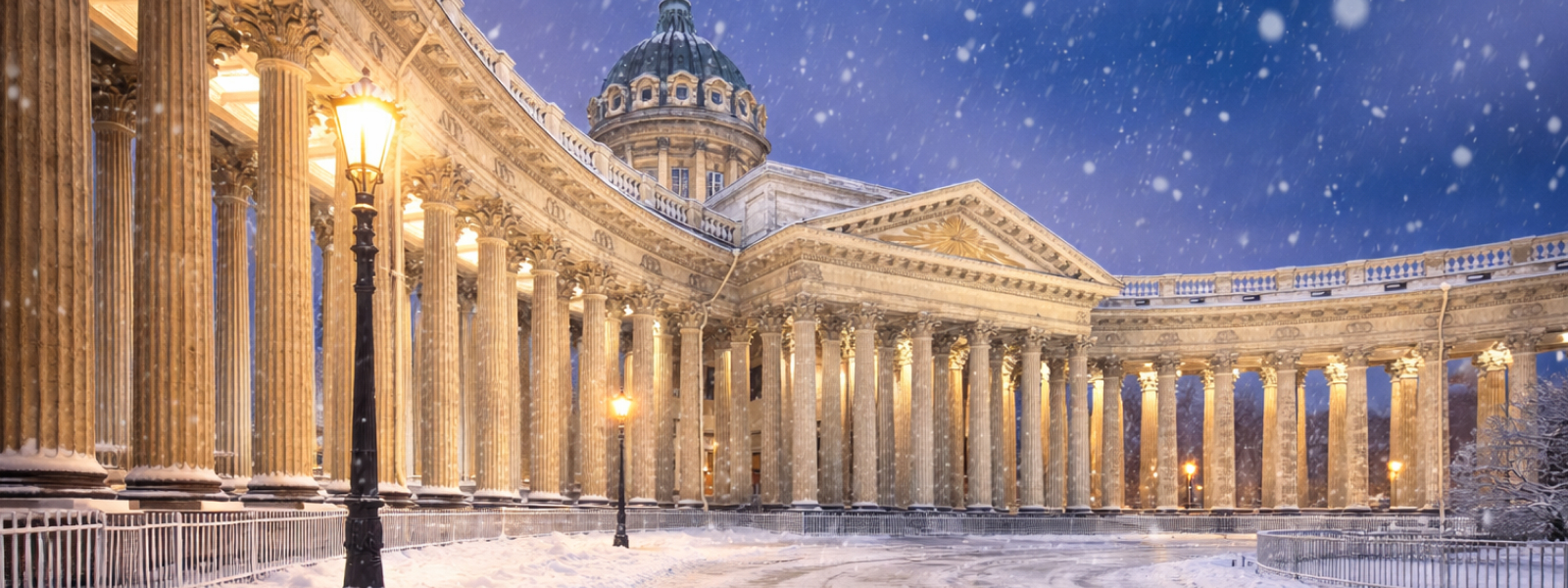
94 (or 96 in four rows) majestic Corinthian columns 13 meters high create the effect of open arms or wings, inviting everyone to enter under the vaults of the church.
In the 19th century, it was deservedly considered the tallest building in St. Petersburg, reaching a height of 71.5 meters. If you look at the building from above, it has the shape of a four-pointed Latin cross, where the long part is 72.5 meters, and the short crossbar is 57 meters. The area of the cathedral is 6,200 m² (external) and 4,000 m² (internal).
The cathedral's dome, 17.7 meters in diameter, became the world's first large dome made of malleable iron. This unique structure supports the "apple" with a cross and is an example of brilliant engineering foresight.
The northern entrance is adorned by the famous gates – a skillful copy of the "Gates of Paradise" of the 15th-century Florentine Baptistery, which depict biblical scenes.
Museum of Russian Natural Stone
The cathedral is rightly called a "museum of stone," for it is built exclusively from materials extracted from Russian soil.
Pudost stone: the entire facade is faced with this unique limestone from near Gatchina. It possesses an amazing property: after extraction it is easily worked, and in the air it acquires the strength of brick.
"Rotten stone": the internal columns are made of this durable and beautiful granite, mined in the Vyborg marshes. It received its unusual name because of the specific smell at the mining sites, while remaining an example of reliability.
Noble materials: the interior uses pink Finnish granite, Karelian marble, crimson porphyry, jasper, and shungite.
Interiors and shrines of the cathedral
Inside, Kazan Cathedral resembles a bright and solemn palace hall, filled with air and light.
The interior space of Kazan Cathedral is formed by 56 columns of pink Finnish granite. The stone was quarried on the shores of the Gulf of Finland, and all the work was supervised by the stonemason Samson Sukhanov. The columns were first processed at the quarry, then delivered by water to Petersburg, where they were given their final shape. Only after their installation did the construction of the walls begin – the same principle was applied in the construction of St. Isaac's Cathedral.
The columns divide the church into three naves. The central nave is significantly wider than the side ones and is covered by a semicylindrical vault, decorated with metal flowers. This decor echoes the patterns of the marble mosaic floor and creates a sense of the interior's integrity.
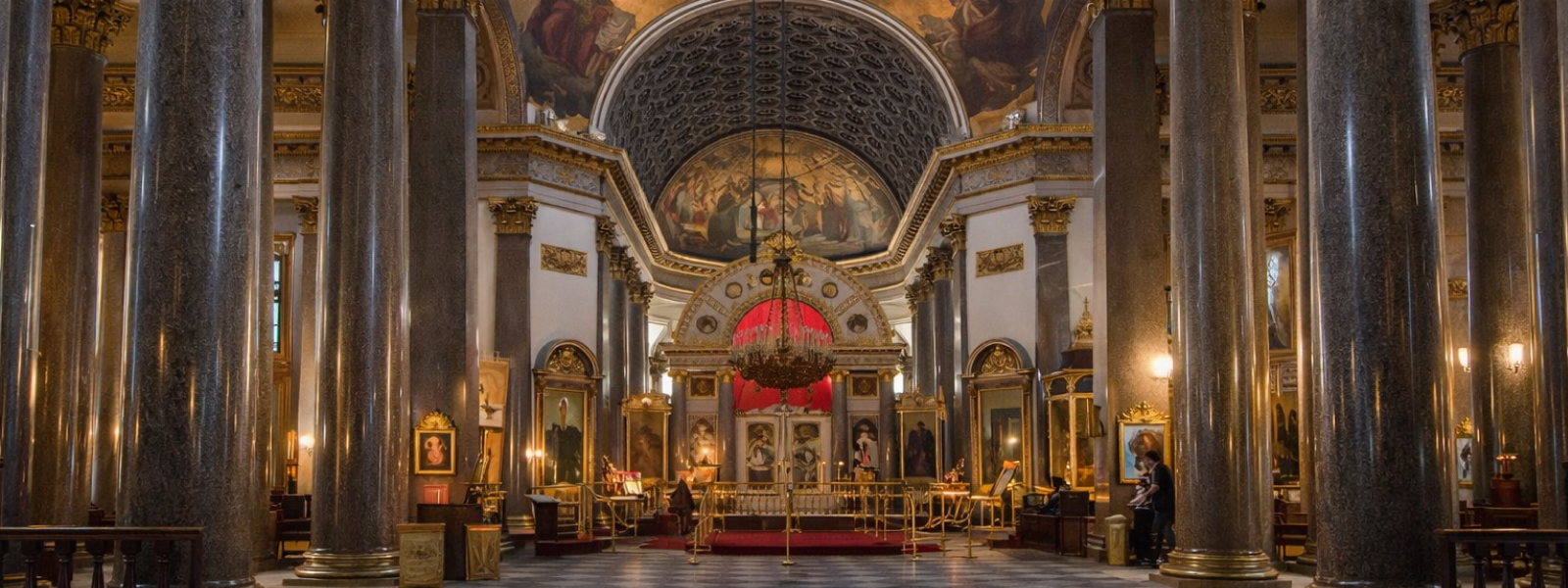
The church contains memorial plaques in honor of the architect Andrey Voronikhin, Count Alexander Stroganov, and Emperors Paul I and Alexander I. Here also is the grave of Field Marshal Kutuzov, above which is placed a painting connected with the history of the Kazan Icon and the victory of the people's militia in the 17th century.
Kazan Cathedral has three altars, as well as a winter chapel of the Hieromartyr Hermogenes with a font for adult baptism. Next to the dome pillar is the Tsar's Place made of Tivdia marble, executed according to Voronikhin's design.
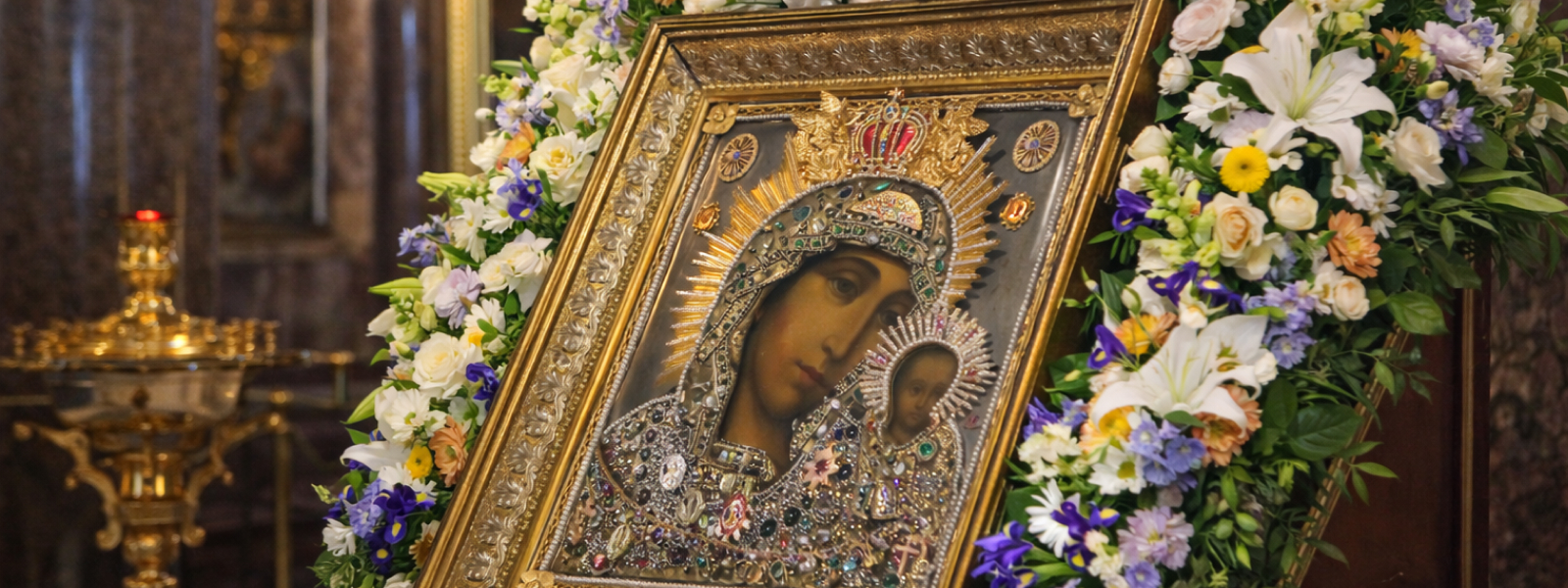
The main pearl of the church is the copy of the Kazan Icon of the Mother of God, installed to the left of the Royal Doors. This icon is considered one of the most revered in Orthodoxy. People come to pray to it for family, health, protection, and well-being, and for many believers it has special spiritual significance.
The cathedral is a monument to the victory in the Patriotic War of 1812. Here is the grave of the great commander Mikhail Kutuzov, decorated with trophy banners and keys from captured European cities.
A special place in the cathedral is the "Jerusalem niche" in the southern wall. It was created in gratitude for the miraculous salvation of the family of Emperor Alexander III during the train crash in 1888.
Museum of Religion and Atheism
In 1932, the Museum of the History of Religion and Atheism opened in Kazan Cathedral. This decision was part of the general policy of that time: many churches in the country were closed or transferred to new, secular functions. Kazan Cathedral turned out to be convenient for this – a large building in the city center, well-known, noticeable, with an already established history.
The museum was not created as a random exhibition. It was conceived precisely as a space where religion is shown from the point of view of history and science, and atheism – as a "natural stage in the development of society." Thus the cathedral ceased to be an active church and became a place where tours were conducted, school groups, students, and tourists were brought.
Inside, people saw first of all authentic objects, and this is important to understand. Icons, crosses, church utensils, ancient books – all of this was real, not replicas. It simply stood not by the altar, but in display cases, with labels and explanations.
Besides Orthodoxy, the museum had halls dedicated to other religions of the world. Islam, Buddhism, Judaism, ancient beliefs – ritual objects, symbols, images, elements of worship. For many visitors this was their first encounter with religion at all, albeit in this format – through a museum and explanations "from the perspective of time."
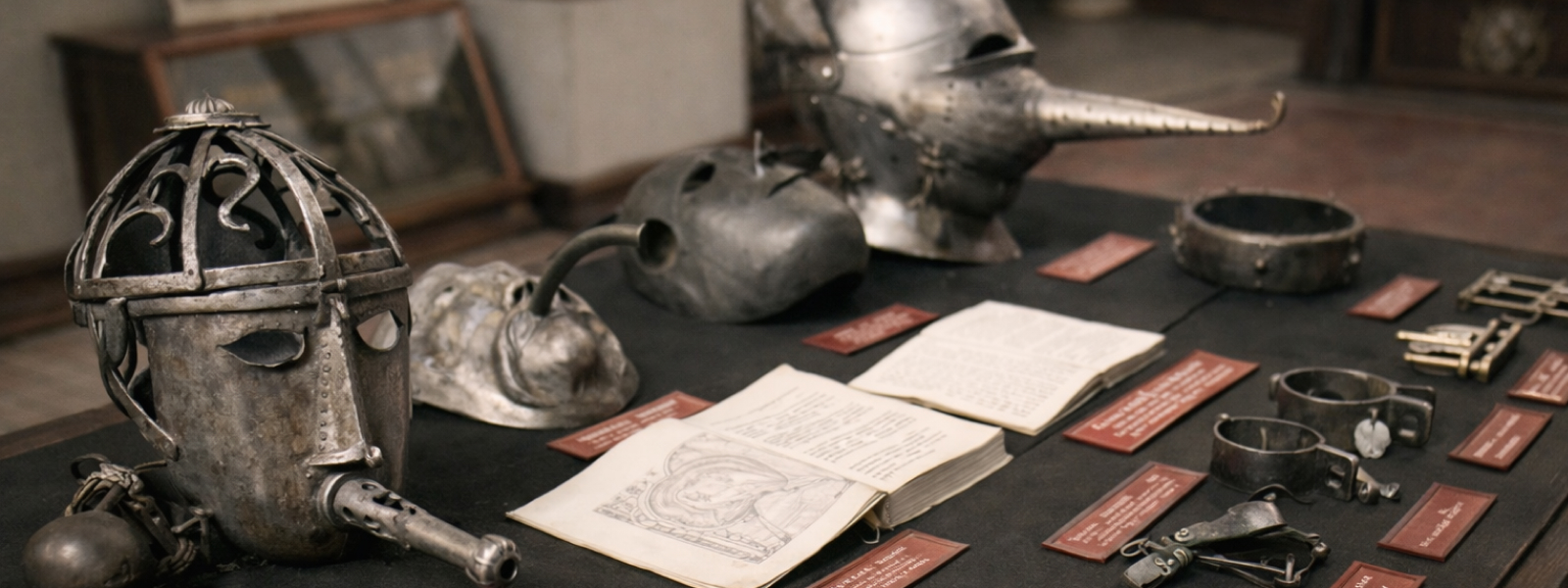
A separate place was occupied by exhibitions about atheism. Posters, schemes, diagrams, texts about the development of science, about how man supposedly gradually renounces faith. All of this looked rather straightforward and reflected the spirit of the era.
The strongest impression for many was the contrast. The huge dome, the columns, the scale of the church – and at the same time museum display cases, guides with pointers, schoolchildren with notebooks. Even those who did not think about meanings remembered precisely this feeling of mismatch between form and content.
The Museum of the History of Religion and Atheism was located in Kazan Cathedral for almost 60 years, until the early 1990s. In 1991 the museum moved to a separate building, and Kazan Cathedral was returned to the Russian Orthodox Church. From that moment it again became an active church.
Kazan Square
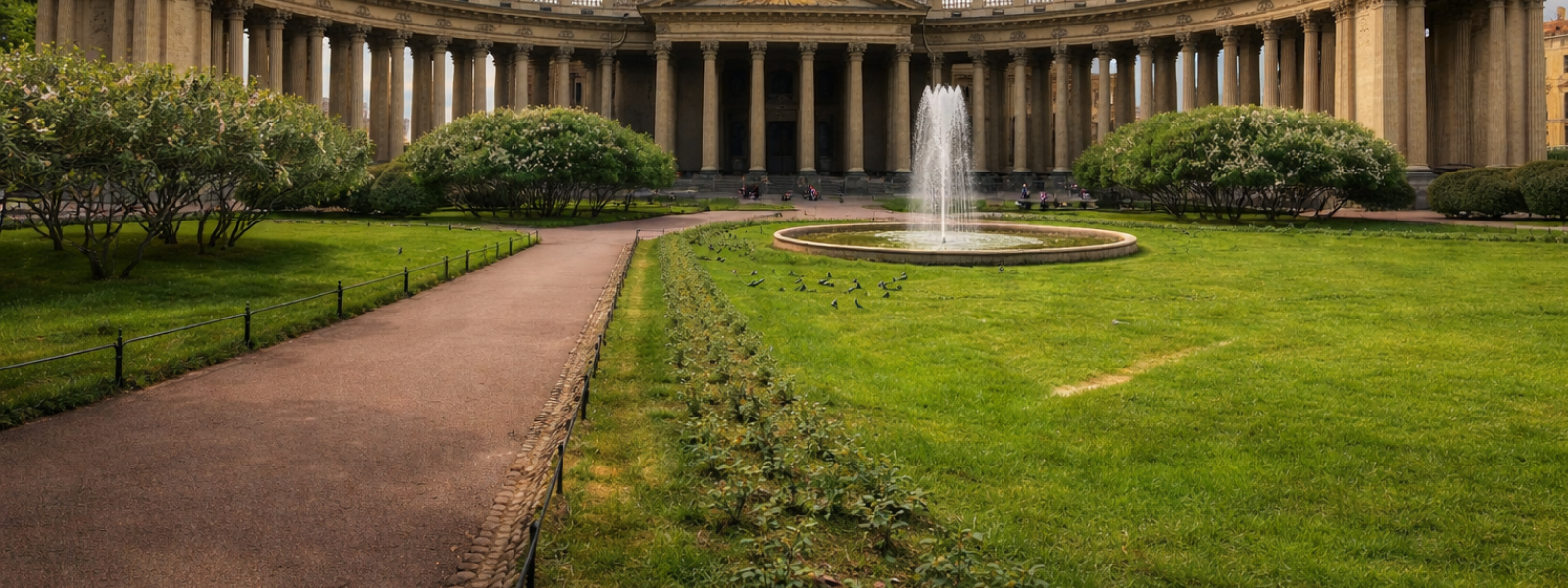
In front of the cathedral lies the beautiful Kazan Square, laid out in 1899–1900. This place is ideal for leisurely strolls, meetings and relaxation in the city center.
The layout of the square resembles a bell in shape, which adds special elegance to the place.
In the center of the square is a granite fountain, created according to the design of Thomas de Thomon and moved here from the Pulkovo Road in 1946. It has long become a point of attraction and an unofficial meeting place.
The square is decorated with well-kept lawns and ornamental shrubs that create an atmosphere of coziness. Along the edges of the colonnade are monuments to the commanders M. Kutuzov and M. Barclay de Tolly, complementing the ensemble of the cathedral.
Kazan Cathedral in winter
In winter the cathedral looks especially expressive: the colonnade is dusted with frost, snow lies all around, and against the dense gray sky the building seems even more austere and majestic. From the outside the scale is immediately felt – the semicircular colonnade embraces the square, in front of it stands the monument to Kutuzov. In the evening the illumination is turned on, and the cathedral looks truly spectacular.
Entry inside is free, the church is open daily from 8:30 to 20:00, and even during popular hours there are usually no crowds here. Inside – silence, diffused light, the smell of incense and candles. The space is held up by tall columns, paintings, gilded icons and mosaics. Here also is the Kazan Icon of the Mother of God, to which believers come.
Kazan Cathedral today: information for visitors
The cathedral is an active cathedral church, and its doors are open to all who wish to enter.
Schedule of services
- Weekdays: The Liturgy begins at 10:00.
- Sunday and holidays: Early Liturgy at 07:00, late – at 10:00.
- Evening service: Held daily at 18:00.
- Children's Liturgy: Once a month, a special service is held in the lower church of the Hieromartyr Hermogenes, where children sing and serve.
When visiting the church, it is recommended to keep silence and turn off the sound of mobile phones. Women are advised to cover their heads, and men to remove their hats. Photography of the interiors is permitted (without flash and not during services).
Tours around Saint Petersburg
Getting to know Kazan Cathedral is only the first step toward understanding St. Petersburg. It immediately sets the scale of the city, its rhythm and mood, but by itself it does not reveal everything. To see St. Petersburg as a whole and without gaps, it is important to go beyond a single point and connect it with the rest of the city.
It is convenient to continue this acquaintance on a sightseeing tour. Cathedrals, embankments, central squares and museums come together into a single picture. The route includes St. Isaac's Cathedral, the Church of the Savior on Spilled Blood, panoramas of the Neva, the Hermitage and the main streets.
Ready-made tours to St. Petersburg from «Ленинград-Тур»
Choose your travel format
The «Ленинград-Тур» website offers tours to St. Petersburg for 2, 3, 4 and 5 days with accommodation, a sightseeing program and a guide. We will help you choose a route for your dates and wishes.
- Programs for first trips and for those returning to St. Petersburg;
- Tours with suburbs, theaters and original routes;
- Options for families, couples, school and corporate groups.
The «Ленинград-Тур» team wishes you genuine enjoyment of St. Petersburg ❤️