Writes about St. Petersburg, its history, sights, museums and routes.

Tsarskoye Selo knows how to make you fall in love, it greets you wonderfully with clean air and the silence of ancient alleys. The place has long been called "Saari Mois", which means "manor on an elevated place. Breathing here is very easy thanks to its location at 120 meters above sea level.
The residence has a fortunate location protected from strong winds, the sun here looks into the windows of the palaces more often than in St. Petersburg. Around you can hear the sounds of nature, the soft rustle of gravel, and in the air you feel the freshness and aroma of century-old trees.
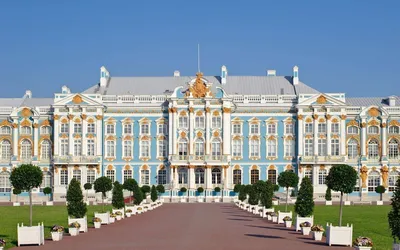
The history of the residence began with a gift from Peter I to his wife Catherine, and since then every particle of the park has kept the warmth of a great past. After getting acquainted with the golden halls of the palaces and the mirror-like smoothness of the ponds, it is very pleasant to continue your rest in cozy cafes and restaurants right on the territory of the museum. From the windows of these establishments, wonderful views of the parade ground and the famous Golden Gates open up, dining here is a complete pleasure.
How the history of Tsarskoye Selo was formed
The lands of modern Tsarskoye Selo have a rich centuries-long history connected with different peoples and states. Initially these were Izhorian territories belonging to Veliky Novgorod. The Finnish population gave this area the name Saari Mois (Saaris moisio).
How Tsarskoye Selo got its name
In 1609 the lands were occupied by the Swedes, who set up a feudal estate here and renamed the Finnish village Saris Gof.
During the Great Northern War the territory returned to Russian control, receiving the name Saarskaya Myza.
In 1710 Peter I officially included the hill and forty-three adjacent villages among the palace lands, gifting them to Marta Skavronskaya (the future Empress Catherine I).
Over time the name transformed: the similar-sounding and close in meaning word "Sarskoye" turned into "Tsarskoye Selo".
Tsarskoye Selo: the era of prosperity
Under Empress Elizabeth Petrovna, Francesco Rastrelli erected the Catherine Palace. In 1745 the Court Resurrection Church was founded, becoming a symbol of festivity and divine beauty. Its walls, painted in Berlin blue, and the gilded carving of the iconostasis still delight every visitor.
Catherine II invited the best masters of her time – Charles Cameron and Giacomo Quarenghi, who added severity and elegance to the ensemble. During this period the Alexander Palace and shady landscape parks appeared.
For Alexander I, Tsarskoye Selo became a native place where he spent time in silence and focused work. In 1837, Russia's first passenger railway opened here, connecting the residence with the capital.

In 1887, the city became the first in Europe whose streets received full electric lighting. It was also here in 1898 that the country's first motor race took place, and the young heir Alexei Nikolaevich happily rode in his car along the park's alleys.
A special place in history is occupied by the Tsarskoye Selo Lyceum, which became a "city of muses" for Alexander Pushkin. The sounds of the lyceum bell and the traditions of strong brotherhood forever linked this place with great Russian literature.
Tsarskoye Selo today
Tsarskoye Selo is a huge "city-park" covering 300 hectares. It is considered one of the carnival capitals of the world – large-scale celebrations, processions and festivals are regularly held here.
Formally it is a district of St. Petersburg, but it feels like a separate fairy-tale town, and it is best to set aside at least two days to explore it. In this place you can fully immerse yourself in the atmosphere of the past: ride a real gondola on the Great Pond, travel along the alleys in an electric car or a horse-drawn carriage, and even stay overnight at the "Ekaterina" hotel, located right in the building of a palace wing.
For those who are hungry, cozy establishments operate on the grounds: for example, in one of the Admiralty's "Bird Houses" a restaurant is open, and in another – a pastry shop. And from the banquet hall in the circumferentia building there is a stunning view of the parade ground and the Golden Gates of the Catherine Palace.
Catherine Palace
Acquaintance with Tsarskoye Selo most often begins right here. The Catherine Palace is a ceremonial residence in the style of lush Baroque, finally completed in the 18th century with the participation of Francesco Rastrelli. Inside the palace are ceremonial halls arranged in the Golden Enfilade.
The main highlight is the Great Hall. It is flooded with daylight thanks to tall windows reflected in mirrors, and seems even larger due to gilded stucco and ceiling paintings. Balls, receptions and official ceremonies were held here. Photos taken in this hall cannot be compared with anything.
Further on, the enfilade unfolds in a series of ceremonial drawing rooms and dining rooms. In them, attention is drawn to carved gilded details, parquet floors of intricate design, tiled stoves and furniture created specifically for the palace. Some halls are decorated in different color schemes, with both light tones and rich green and blue.

The Amber Room
This is a gift from the Prussian King Frederick William to Peter I as a sign of strengthening the state union. Due to the exceptional fragility of the panels and details of the study, they were delivered from St. Petersburg to Tsarskoye Selo literally by hand.
The history of this masterpiece is full of drama: during World War II the room was taken by the invaders to Königsberg, where it disappeared. Today one can admire only the fully recreated interior of the Amber Room, on which restorers worked for decades, completing the work for the 300th anniversary of St. Petersburg.

Tsarskoye Selo Lyceum
The Lyceum was opened in 1811 by decree of Alexander I as an elite school for noble children, where education was equivalent to university level.
Now it is a museum where the authentic atmosphere of the life of the first, most famous graduating class has been recreated. You can go up to the third and fourth floors, to see the Great Hall, classrooms, the newspaper room and even the dormitories of the students themselves. The museum's library still preserves real lyceum books of the 19th century that were held in the hands of the students.

Walking past the lyceum students' rooms, it is easy to imagine how young poet friends ran along these corridors. The spirit of "lyceum brotherhood" reigns here, symbolized by cast-iron rings in the form of intertwined hands.
Here Alexander Pushkin spent his youthful years and formed as a poet. The city is so imbued with his memory that in 1937, on the centenary of the poet's death, Tsarskoye Selo was officially renamed in his honor – Pushkin.
Catherine Park
This is the center of the museum-reserve, covering more than 100 hectares, comparable to 150 football fields. It includes the formal Old Garden with straight alleys and the landscape part around the Big Pond. In the park are the Hermitage Pavilion with historic rising tables, the Grotto exhibition hall, and the Admiralty complex, which now houses a restaurant and a confectionery.
The park has many photogenic spots, such as the Marble Bridge and the Cameron Gallery with columns and busts of great thinkers.

Alexander Park
It is almost twice the size of Catherine Park, and unlike its neighbor, it offers free entry and a lack of crowds. Here you'll find the Big Chinese Bridge with figures of Chinese people, the unusual Chinese Village where the historian Karamzin once lived.
In the middle of the park stands the Alexander Palace – a place with a very strong and somewhat sad energy. Unlike the golden splendor of the Catherine Palace, this classical-style building looks much cozier, as from 1904 it was a true home for the family of Nicholas II. These walls witnessed the twilight of the empire: from here, early in the morning of August 1, 1917, the Romanovs left their home forever, going into exile.

You can come to Tsarskoye Selo on your own, stroll along the alleys, peek into palaces, read plaques, and piece the picture together bit by bit. Or you can take another path – choose a guided tour and let the place unfold into a coherent story. The trip begins with a bus tour, during which the guide talks about the history of these places, their connection to the imperial era, and the life of the residence. The tour includes a walk through the park, a visit to the Catherine Palace, and a visit to the famous Amber Room.
At the end of the route, a transfer to Moskovsky Railway Station is provided, so your return to the city is as convenient as the start of the journey.

Excursion to Pushkin from Saint Petersburg
Visit Tsarskoye Selo →