


Writes about St. Petersburg, its history, sights, museums and routes.

Historian and guide, specializing in St. Petersburg, Pavlovsk, and Tsarskoye Selo.
The Amber Room is often called the eighth wonder of the world. The story of its creation reads like a detective novel, and its fate was difficult and long. But the main impression is born inside the room itself. It looks cohesive and thought through down to the smallest detail.
Amber is rarely seen as just a decoration. It's warm to the eye, rich in color, with noticeable depth.
In the 18th century, it was valued as a special "warm stone" capable of retaining and giving off heat. At court, it was attributed protective properties, especially regarding health. Children wore amber jewelry, and it was used in the interiors of chambers where people spent a lot of time. Today, the Amber Room is located in the Catherine Palace in Tsarskoye Selo — in the very hall for which it was conceived and where it found its finished form.How the Amber Room came to be
The history of the Amber Room begins in the early 18th century, in Prussia. It was there that the idea arose to create a ceremonial interior entirely decorated with amber. For its time, this was a bold idea: amber was considered a rare material requiring a special approach and great skill. It was difficult to process in the standard way, was fragile, and yet produced an unusual visual effect. Even then, it was clear that this was a complex artistic task.
In Europe, amber was also used for centuries as an amulet and apothecary raw material: tinctures, "amber oil," powders, and salts were made. This coexisted peacefully with the idea of its protective properties — for the home, for the family, for children.
The amber panels were crafted in the royal workshops. Masters selected stones by shade — from light honey to deep cognac, assembled mosaics, and designed ornaments and the combination of amber with gilding, mirrors, and carving. The panels were created by hand, fragment by fragment. Throughout the process, there was a constant search for balance between color, light, and surface relief. Amber demanded patience, precision, and time.
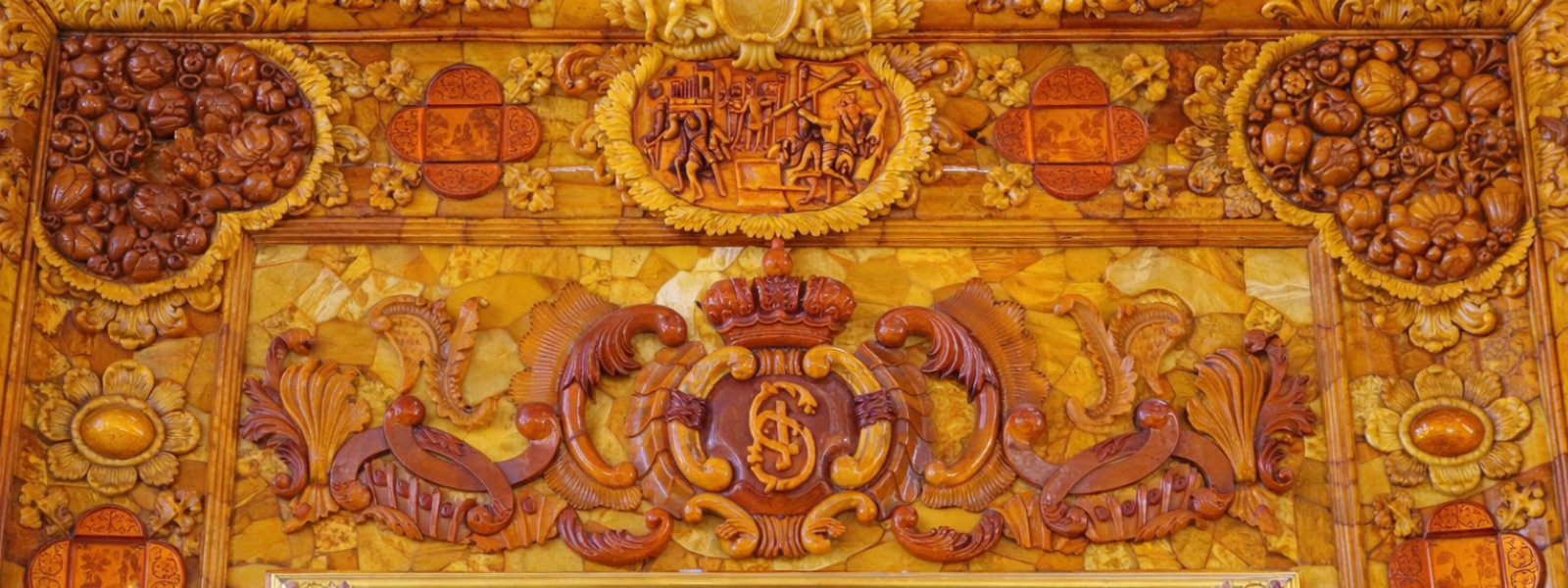
In 1716, the amber cabinet was presented as a gift to Peter I by the Prussian King Frederick William I. The gift had a special meaning. It was perceived as a sign of respect, allied relations, and recognition of Russia's role in European politics. For Peter I, who was attentive to art, crafts, and new technologies, this gift became a symbol of opportunities and cultural dialogue between states.
After the transfer, the amber panels remained assembled for some time without a final purpose. They awaited a space that could emphasize their scale and artistic value. Such a space was found already in Russia. In the era of the flourishing of imperial residences, architects and court masters turned their attention to the amber cabinet.
The Amber Room in Tsarskoye Selo
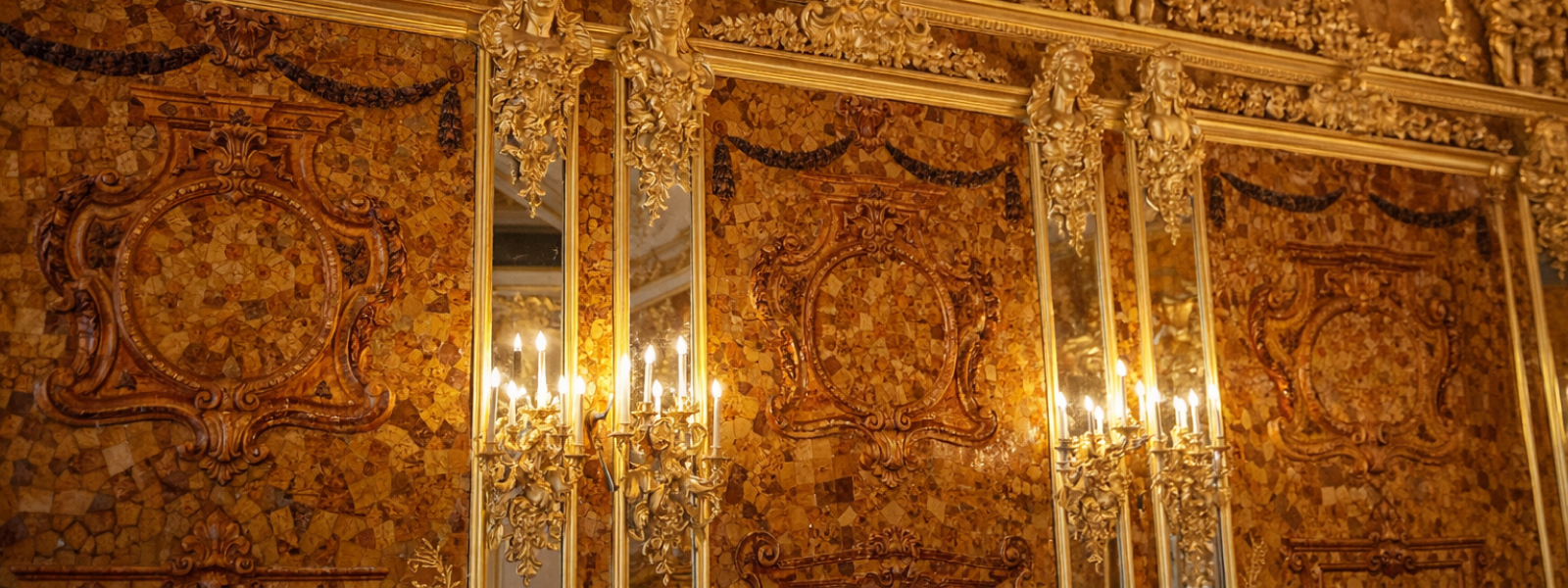
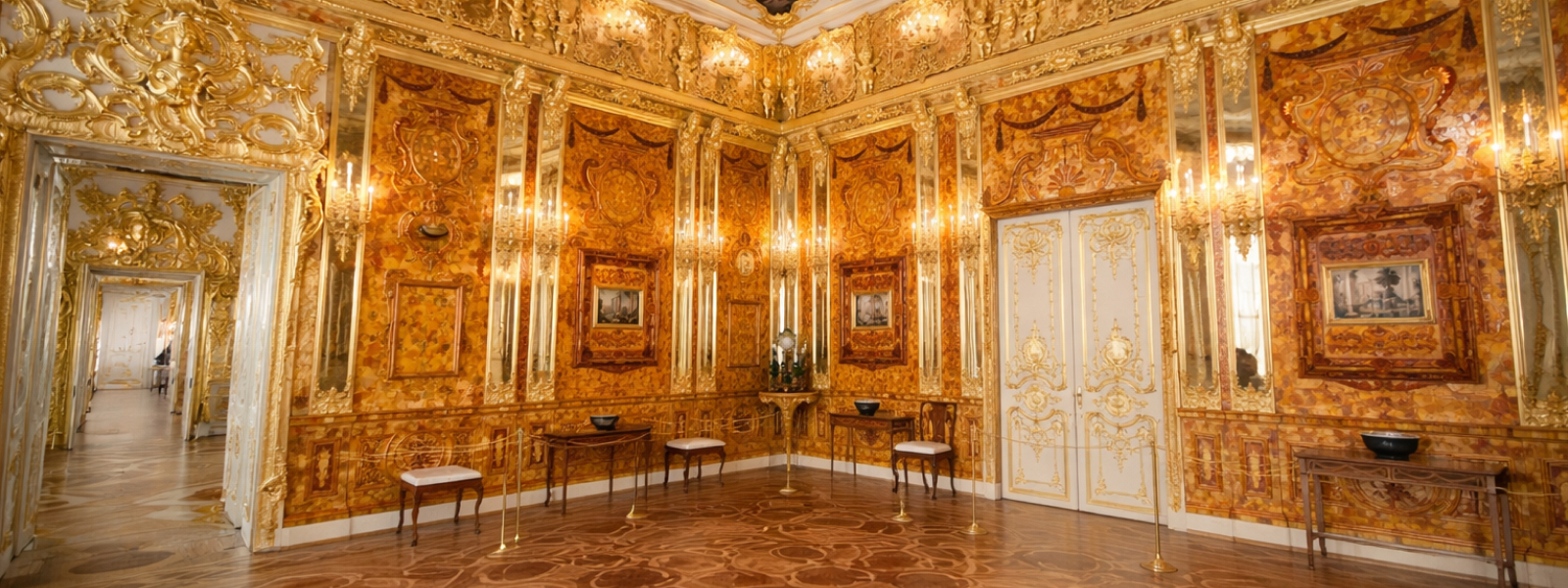
Under Elizabeth Petrovna, the Amber Room gained new life. Then architect Bartolomeo Rastrelli transformed the amber cabinet into a grand state hall, complementing it with mirrored pilasters, gilded carving, and mosaics. The space became deeper, brighter, and more solemn.
By 1770, already under Catherine II, the decoration was completed. The Amber Room became an integral part of the Catherine Palace — a place for receiving guests and intimate meetings. Here they played cards, conversed, and admired the play of light on the amber panels. The room lived a full palace life.
Disappearance and return of the legend
The fate of the original Amber Room became one of the most famous mysteries of the 20th century. During the Great Patriotic War, the interior was removed from the Catherine Palace, and its subsequent journey gave rise to dozens of versions and studies. This story still arouses interest among historians and researchers worldwide.
But for visitors to Tsarskoye Selo, something else is more important. At the end of the 20th century, a decision was made to recreate the Amber Room. The work lasted more than twenty years. Masters used Kaliningrad amber, archival photographs, drawings, and surviving fragments.
In 2003, for the 300th anniversary of Saint Petersburg, the Amber Room reopened to visitors. Today it is perceived as a continuation of history — careful, respectful, and very precise.
Why you should see the Amber Room in person
No camera can convey what you feel when you enter the Amber Room. In photographs, it is beautiful, elegant, 'golden.' In real life, everything looks different.
The first sensation is light. It softly spreads across the hall. Amber looks as if there is honey inside it, warm and thick. Somewhere the shade is lighter, almost like melted butter, somewhere darker — like cognac in a glass. You step aside — and the color is already different. You come closer — the amber becomes deeper, richer.
This cannot be captured in a photo. The camera records color without catching the transitions. Here, everything is built precisely on them.
Amber has natural antiseptic properties: it does not accumulate moisture, does not attract dust, and does not create an environment for bacteria. Near the amber panels, a very characteristic sensation arises — of cleanliness and dry, 'even' air.
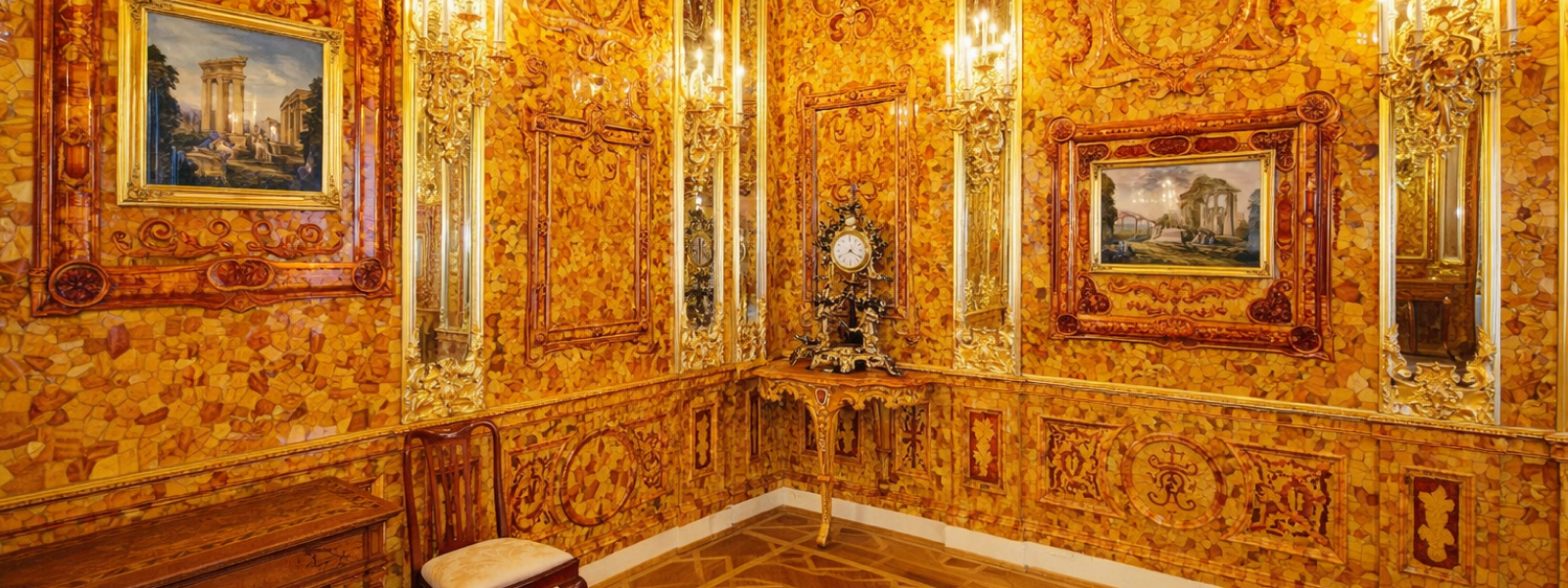
The panels are arranged in several tiers, with mirrored pilasters between them, enhancing the effect of space. Florentine mosaics attract the eye with their picturesqueness. Many note that time in this hall feels slower.
One of the mosaics — "Touch and Smell" — is the only authentic work from the series that went through loss, searches, and return. It disappeared during the war, surfaced decades later on the antique market, and only in 2000 returned to Tsarskoye Selo. This is a specific object that has passed through time, countries, and people's fates.
The Florentine mosaics "Sight," "Hearing," "Taste," and "Touch and Smell" were created as a single artistic concept, a gift to the imperial court. They are made of semi-precious stones and marble, assembled by hand with jewelry precision. Up close, you notice how the stone "carries" color: in places it is dense and dark, in others almost transparent, in others softly matte. These transitions cannot be seen on a screen — they are visible only from arm's length.
A special impression is made by the realization that the recreation of the mosaics proceeded almost blindly. Restorers worked from black-and-white photographs and old descriptions, later, during the process, they found painted sketches according to which the originals were once created. Thanks to this, it was possible to restore the exact color scheme and stone selection. In one composition, jaspers, lapis lazuli, quartzite, porphyry are combined — materials with different textures and "behavior" in light. The eye reads this instantly, even if you do not know the names of the stones.
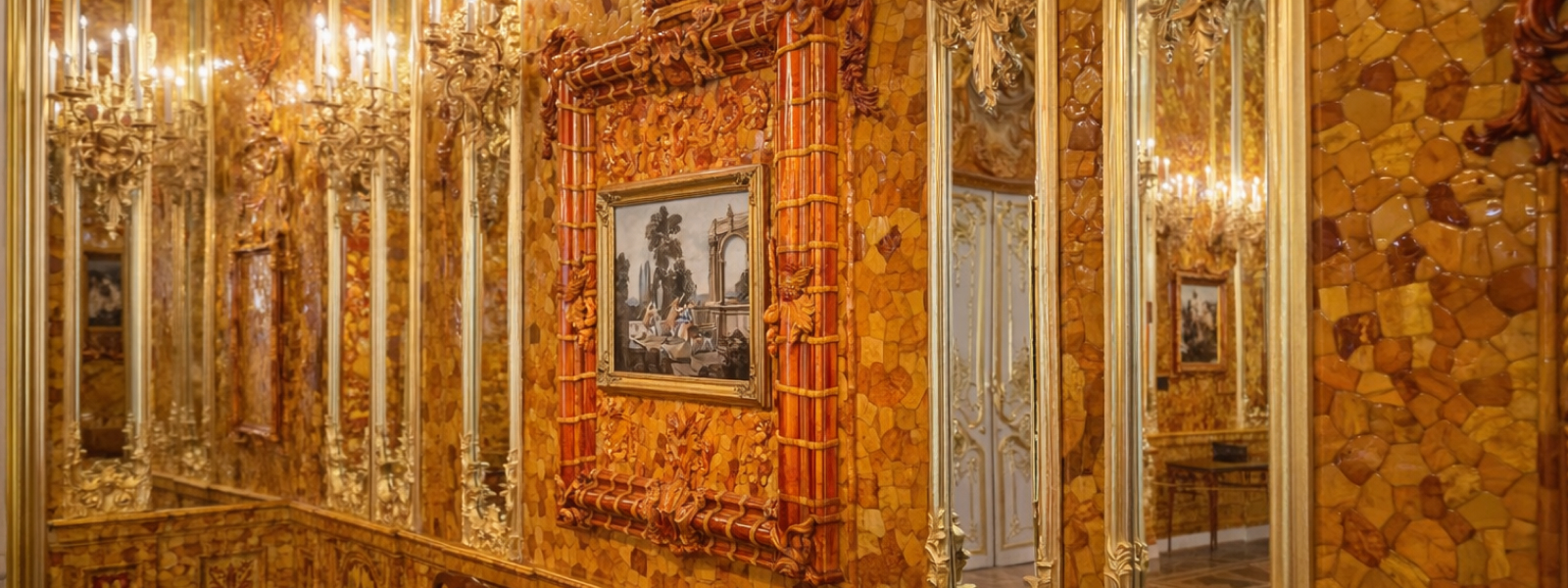
For some, this is a first acquaintance with imperial Petersburg, for others — a long-awaited meeting with a legend. Very often people leave the hall with the feeling that expectations matched reality, sometimes even exceeded them.
Excursion to Tsarskoye Selo with a visit to the Amber Room
A visit to the Amber Room is included in the program of the bus excursion to Tsarskoye Selo — the town of Pushkin, one of the most famous suburbs of Saint Petersburg.
The trip begins with a highway excursion, during which the guide talks about the history of these places, their connection with the imperial era and the life of the residence.
The excursion includes a walk in the park, an introduction to the Catherine Palace, and a visit to that very great Amber Room.
At the end of the route, a transfer to Moskovsky Railway Station is provided, so that the return to the city is as convenient as the beginning of the journey.

Excursion to Pushkin from Saint Petersburg
Visit the Amber Room →








