


Author of materials about St. Petersburg, travel, excursions, and city routes.
Museum guide to art, culture and St. Petersburg of the 18th–19th centuries.
The whole world knew Leningrad as the "city of golden spires"; during the siege, the Germans planned to wipe it off the face of the earth precisely by those spires. German artillerymen had maps in their tablets where our cathedrals and domes served as ideal reference points for sighting. The city needed to "disappear" urgently, and Leningraders did the incredible: hungry, freezing people climbed hundreds of meters into the sky to cover architectural monuments from shells.
How the city was hidden: paint for destroyers and plywood houses
The city was camouflaged by any means possible. The simplest way was to paint the gold with gray oil paint, the kind usually used on warships: it blended perfectly with the gloomy St. Petersburg sky. Those monuments that could not be painted were sewn into huge tarpaulin covers. Architects also specially built entire false blocks and plywood copies of buildings so that the Germans would bomb dummies.
St. Isaac's Cathedral
The cathedral became one of the first objects of camouflage, as its huge dome "glinted" and was visible from any point in the city. Unlike gold leaf, the dome of St. Isaac's was gilded by electroplating, which made it possible to paint it with gray oil paint. This paint ("ship paint") blended with the gloomy sky and was easily removed with chemicals after the war.
The feats of St. Isaac's CathedralPeter and Paul Fortress
Camouflaging the spire of Peter and Paul Cathedral became a true feat of climbers in the fierce winter of 1941–1942. The climbers worked at a height of 122.5 meters in frosts down to -42 degrees and stormy winds that made the spire sway with an amplitude of up to 2 meters. To avoid wasting energy on the journey, the steeplejacks lived right in the cathedral and worked under shelling. Like St. Isaac's, the spire of Peter and Paul was painted with gray camouflage paint.
The Admiralty
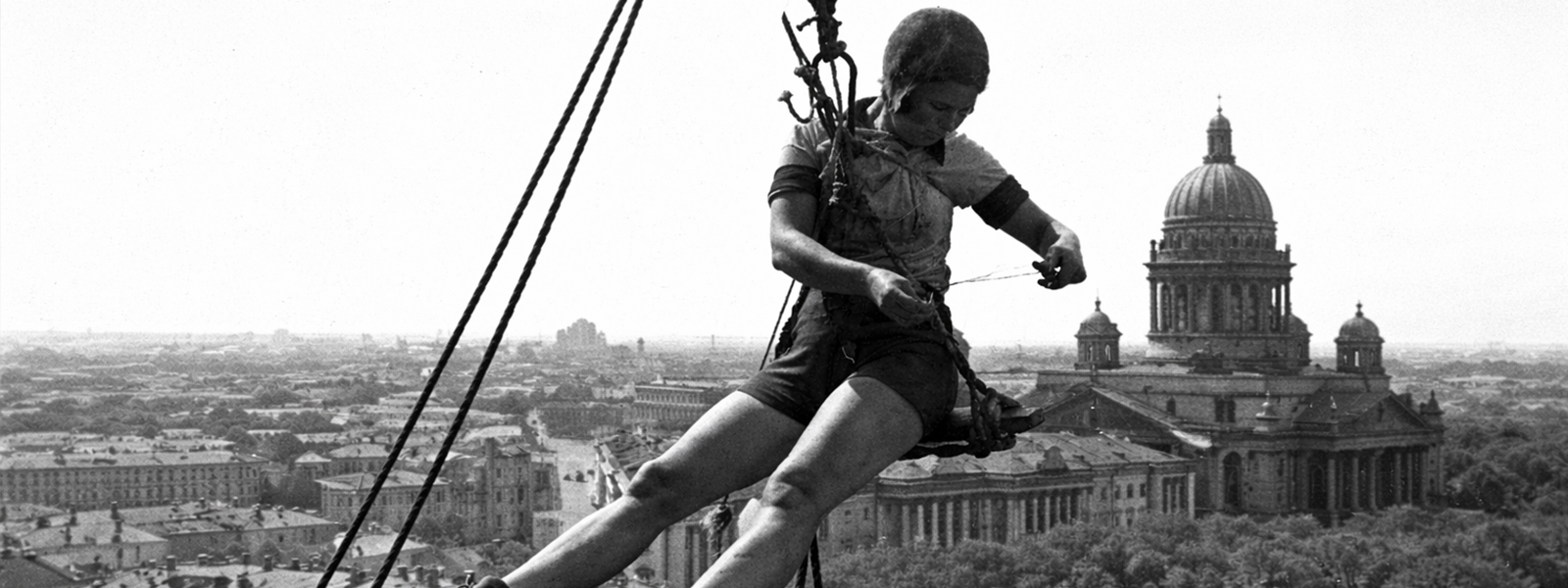
Since the gilding of the Admiralty spire was done by applying the finest gold leaf, it could not be painted — the solvent would have destroyed it. To secure the blocks at a height of 72 meters, a balloon (aerostat) was used, from which a rope was thrown onto the top. Climbers Mikhail Bobrov and Aloiz Zemba climbed up it, and then female climbers sewed the cover panels right in the air.
Smolny Institute
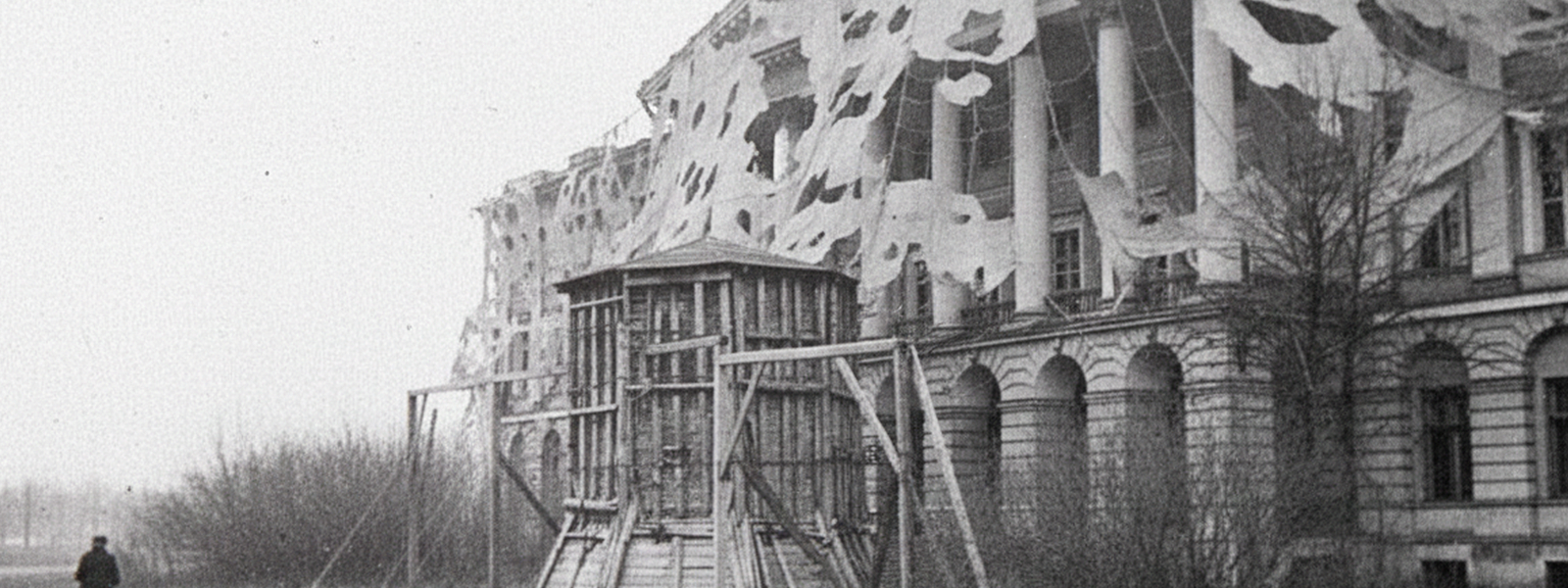
The silhouette of the building was hidden with painted panels and stretched nets with appliqués imitating foliage. To make it more convincing, real branches were woven into the nets. Leningrad botanists developed a special compound for preserving cut vegetation so that the branches would not wilt and would retain their natural color all season without giving away the camouflage in aerial photography.
The Bronze Horseman
It was decided not to evacuate the monument to Peter I on Senate Square, but to protect it in place. First, the monument was surrounded with sandbags (brought from the shore of the Gulf of Finland), and then covered with a massive wooden box-case. From above, this structure resembled a pile of ruins. Due to prolonged contact of the bronze with damp sand, spots of patina in greenish and whitish shades appeared on the monument, which restorers are still trying to even out.
The Horses of the Anichkov Bridge
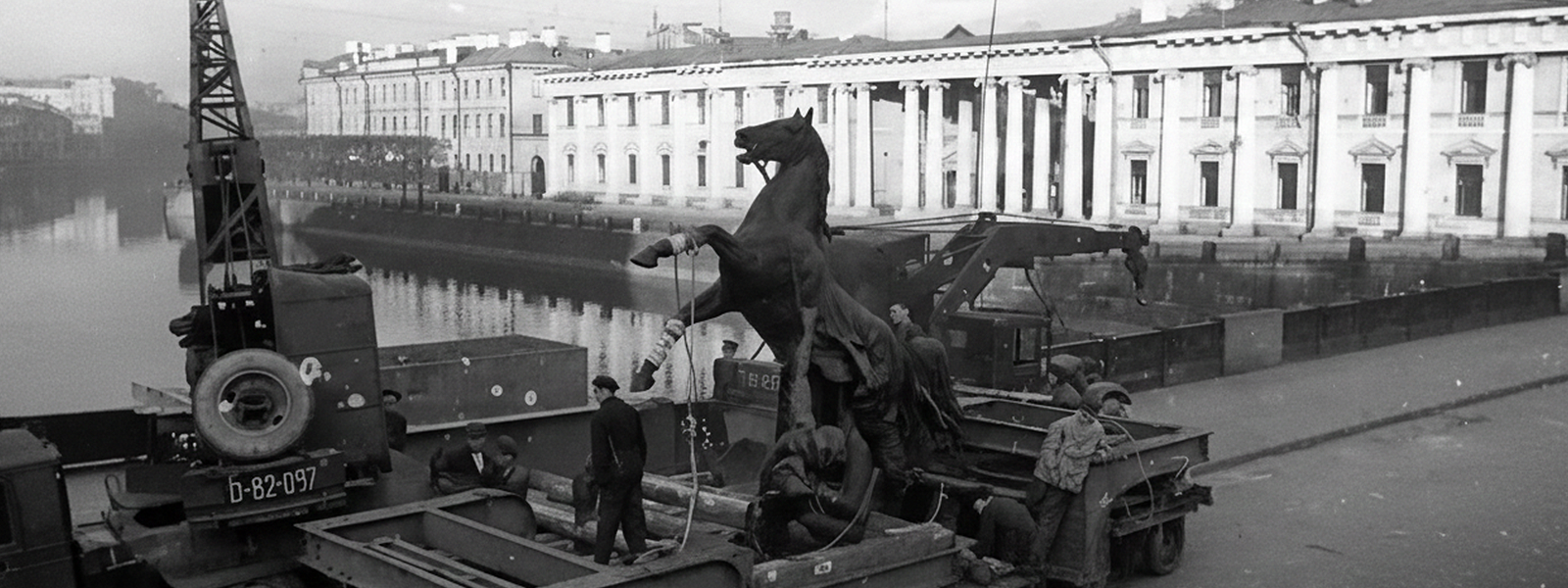
The famous horses from the Anichkov Bridge were removed and buried in the garden of the Anichkov Palace. And for good reason: on the pedestal you can still see the terrible traces of a shell – if the horses had remained there, they would have been blown to splinters.
A feat that preserved the soul of the city
The main heroes of this "invisible" war were a group of climbers: Olga Firsova, Mikhail Bobrov, Alexandra Prigozheva, Aloiz Zemba and Mikhail Shestakov. People who received 125 grams of bread a day found the strength to save both themselves and the cultural heritage of their country.
After the siege
Thanks to their courage, when in June 1945 Klodt's horses began to be taken out of the ground and returned to the bridge, the entire Nevsky Prospect was filled with people. They wept with pride and happiness, realizing: they had not just survived, they had saved the beauty and soul of their city. It is precisely thanks to the feat of ordinary people like you and me that today we see Saint Petersburg as beautiful as the emperors saw it.
Architectural monuments during the siege: answering questions
-
Why weren't all monuments protected?
The main reasons were the lack of time, people and resources in the harsh conditions of 1941 — for example, the Pushkin monument on Pushkinskaya Street simply could not be covered before the raids began. Some monuments, such as those to Suvorov, Kutuzov and Barclay de Tolly, were deliberately left open so that the images of great commanders would inspire Leningraders to fight. -
Where exactly in the city center were plywood dummy houses installed to deceive pilots?
On the square in front of the propylaea of the Smolny Institute, also near the railway stations and on the roofs of large industrial enterprises to create the illusion of ordinary city buildings. -
Were all the landmarks saved during the siege?
Unfortunately, no. Although the main sculptural monuments in the city center survived, during the siege 187 historic buildings erected by great architects were destroyed or damaged. The Gostiny Dvor, the Hermitage, the Kunstkamera and many palaces were seriously damaged, and the Yelagin Palace burned down completely.
Tour of besieged Leningrad
If you want to immerse yourself even more in the history of wartime St. Petersburg, Leningrad Tour has prepared an excursion for you.
Besides St. Isaac's Square you will visit the Piskaryovskoye Memorial Cemetery, dedicated to the memory of all Leningraders and defenders of the city, learn the story of Tanya Savicheva and the fate of the most terrible and tragic diary in history, as well as who now lives in her house, visit the Siege Church, which holds 8,000 named bricks in memory of those who died during the siege of Leningrad.

Tour "Blockade Leningrad"
Go to the tour →








