


Author of materials about St. Petersburg, travel, excursions, and city routes.

Historian and guide for Peterhof, Oranienbaum, and St. Petersburg architecture.
Just 300 years ago, this was the bank of the Neva, constantly flooded; later stood the mansions of the nobility and even the home of court laundresses. Today, it is a key part of the State Hermitage museum complex, housing masterpieces that people come from all over the world to see.
The story of its appearance: when there was too little space for paintings
It all began when Catherine II's collections grew so rapidly that the halls of the neighboring Small Hermitage could no longer accommodate all the acquisitions. In 1770, the empress ordered the construction of a new building 'in line with the Hermitage.' Architect Yuri Felten built it in several stages from 1771 to 1787, gradually buying up and demolishing neighboring plots.
By the way, the name 'Big' appeared simply because of the building's size – it was significantly larger than its predecessor. And the prefix 'Old' was given to the building in the mid-19th century, when the New Hermitage grew next to it.
The architecture of the Old Hermitage: a single labyrinth
Externally, the building looks very calm and neat without excessive pomp, which is characteristic of the classical style. The facade is decorated with lion masks and bas-reliefs.
Inside, the Hermitage building is a single labyrinth of passages and bridges. The Big Hermitage is connected by a glass passage to the Small Hermitage, and through the famous arch over the Winter Canal, you can go straight into the Hermitage Theatre.
Interesting fact: when one of the passages between the buildings was constructed in the 1930s, the architect used marble from Nicholas II's personal pool, so today visitors literally walk on slabs from the imperial bathhouse.
Halls and interiors of the Old Hermitage
Inside the Old Hermitage, everything literally shines: the halls are decorated with gold, rare colored stone, and expensive wood. The walls and ceilings are covered with elegant paintings and very fine, detailed stucco that you want to examine for a long time. In some halls, ancient windows with colored glass still remain, creating a special light in the room.
In the two-story structure of the Old Hermitage, there are about 30 exhibition halls. On the 1st floor, ancient art is displayed, and the 2nd floor is a huge gallery of Italian art, featuring works from the museum's oldest 'Crucifixion' of the 13th century to famous paintings of the Renaissance.
Leonardo da Vinci Hall
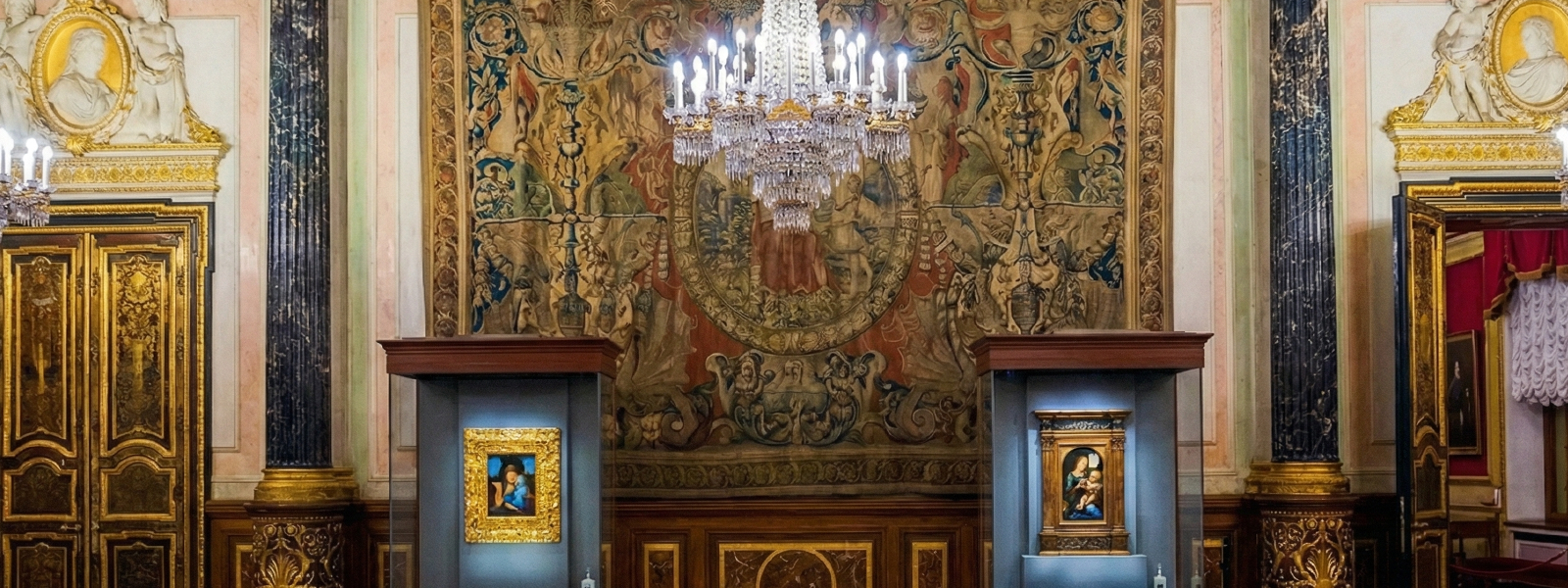
On the second floor of the Large Hermitage is Hall No. 214, which in the mid-19th century was turned into a ceremonial space. The history of this place is changeable: the halls where French paintings once hung and heads of Eastern states stayed eventually became home to world masterpieces. Today this space is known as the Leonardo da Vinci Hall, where two of the master's rarest works are displayed at once – the Benois Madonna and the Litta Madonna. Looking at these paintings evokes an amazing feeling of warmth and tenderness. The image of a mother with a child makes you feel unconditional maternal love.
Titian Hall
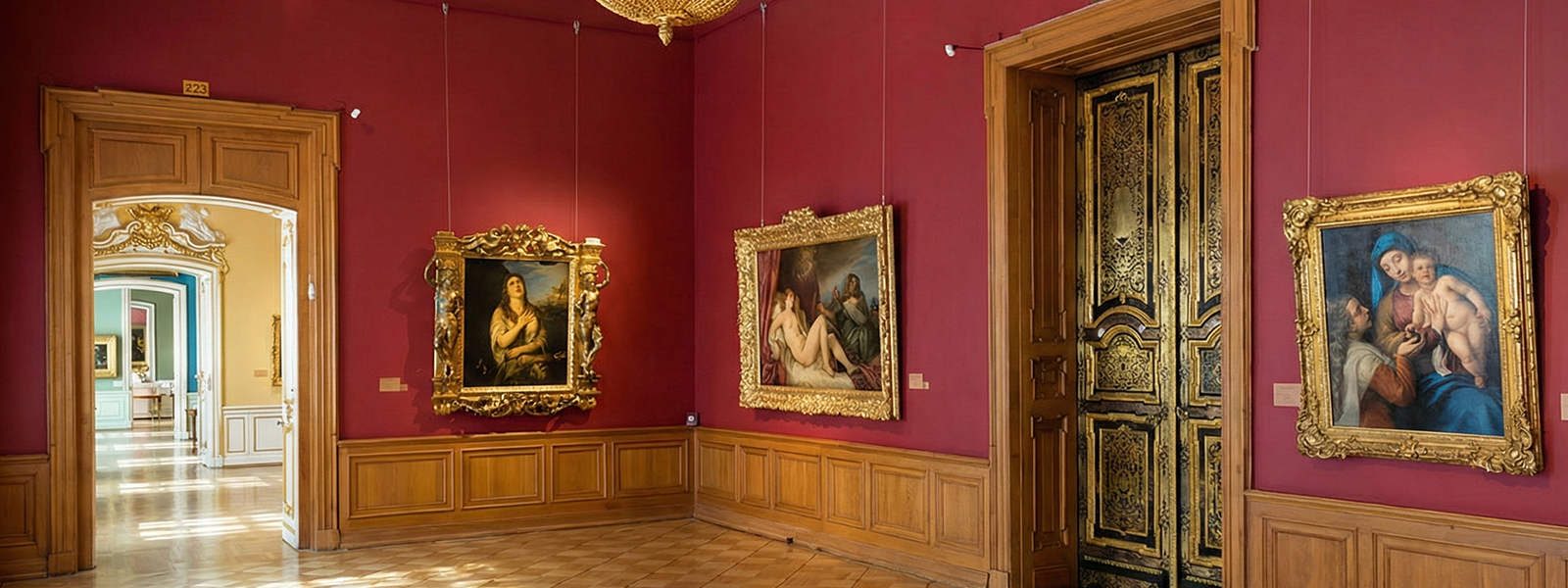
The scarlet walls of the hall on the second floor are adorned with paintings by the Venetian Titian, whose works on biblical and mythological themes are considered the pearl of the Italian art collection. A true magnet for visitors is the canvas Danaë. The painting is dedicated to the main heroine of an ancient Greek myth. Titian was so inspired by this story that he painted five paintings based on the myth's plot, and one of them is kept in the Hermitage.
Soviet Staircase
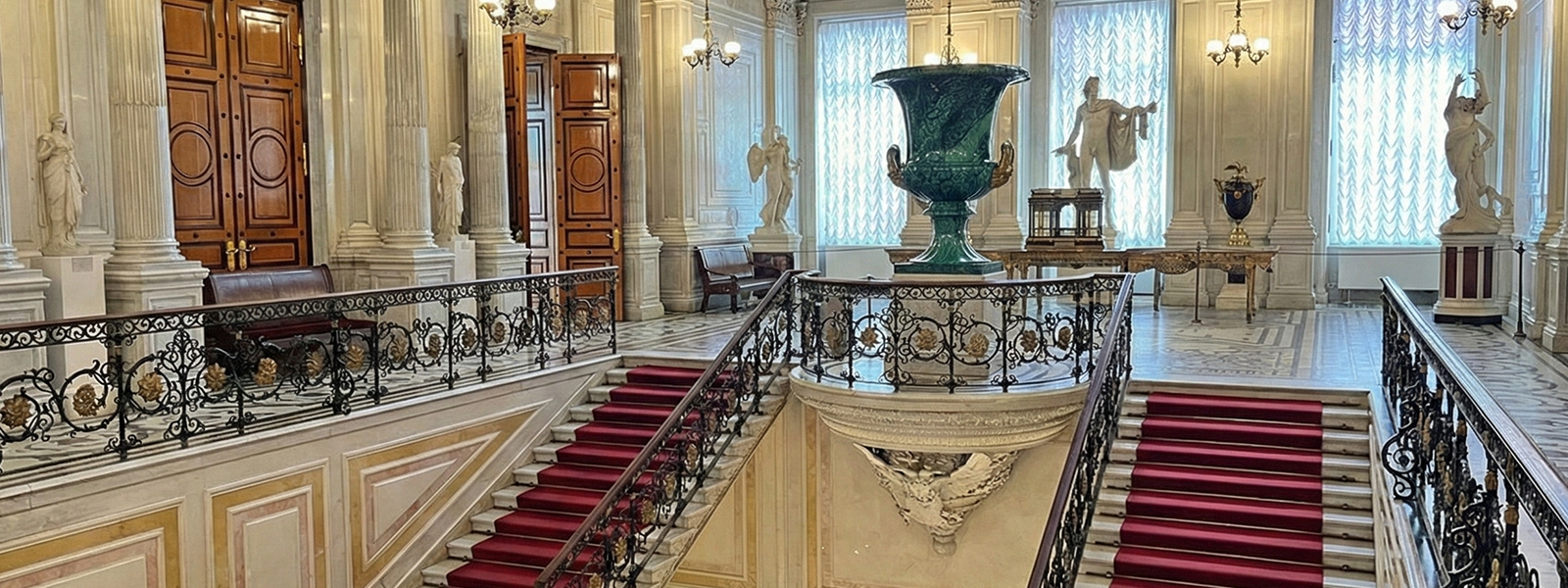
Another amazing place is the Soviet Staircase. Many think the name is connected to the USSR, but in fact it appeared much earlier. In the 19th century, the State Council and the Committee of Ministers met in the halls of the first floor, and dignitaries ascended precisely by this staircase.
The staircase looks very elegant: marble steps, columns of red porphyry and a painted ceiling that once adorned the Oval Hall. It is easy to imagine how officials in uniforms once hurried up this staircase to meetings, because it was here that the fate of the country was decided.
The Old Hermitage: answering your questions
-
Where the Old Hermitage is located
The Old (Large) Hermitage is part of the museum complex on the Palace Embankment and is connected by passages to other buildings of the Hermitage. -
How to get to the Old Hermitage
It is most convenient to enter through the main entrances of the museum complex, and then inside move to the Old Hermitage through galleries and passages between the buildings. -
What to see first
Most often people start from the second floor: Italian painting, halls of Renaissance masters and ceremonial spaces where the interior itself is no less impressive than the exhibits. -
How the Old Hermitage differs from the New
The Old Hermitage was built as an extension of the 18th-century palace museum rooms, while the New Hermitage appeared later and became the first building in Russia designed specifically as a public art museum.
Tour of the Hermitage
If you want to see the Hermitage as a whole, its main staircase, learn the history of the Hermitage cats and look at other priceless exhibits and paintings, then a tour from Leningrad Tour is for you!
In addition to the New Hermitage, the program includes visits to the Church of the Savior on Spilled Blood, the cruiser Aurora, the Peter and Paul Fortress and St. Isaac's Square. You don't need to worry about extra expenses, as entrance tickets to the Hermitage are already included in the price of the trip.

Tour of the Hermitage
Go to the tour →








