


Author of materials about St. Petersburg, travel, excursions, and city routes.

Historian and guide in St. Petersburg, Peterhof, Tsarskoye Selo and Vyborg.
Today St. Isaac's Cathedral is one of the most recognizable and beloved landmarks of St. Petersburg. Its golden dome is visible from various points of the city, and the square itself has long become a place for walks, meetings and tourist routes. It is hard to believe that quite recently the fate of this symbol of St. Petersburg was completely different and very tragic.
The history of the cathedral during the war years is the silence of heroism, selfless labor and the incredible strength of spirit of Leningraders, who managed to preserve art and the city itself even in the most inhuman conditions of the siege.
How St. Isaac's Cathedral became a treasury
St. Isaac's Cathedral, which was built over a long 40 years and was considered the main cathedral of Russia, turned into a powerful granite fortress during the war years. Its massive walls (about 5 meters thick) and «reliable vaults» were a kind of safe for thousands of exhibits that had not been evacuated to the rear before the siege began.
There is an astonishing historical fact: the cathedral's dome served as a landmark for enemy aviation, which is believed to have saved the building from targeted destruction by artillery. German pilots used it as a navigational reference for aiming at other areas of the city, so they tried not to direct direct destructive fire at the cathedral itself.
To deprive the enemy of this beacon, in July 1941 a group of brave mountaineer-athletes accomplished the almost impossible: they manually covered the huge golden dome with special grey paint. The cathedral's appearance in those years became stern and unassailable: the windows were sealed tight with bricks and sandbags, and barrage balloons were raised into the sky along the perimeter.
«United Museum Economy» in the labyrinths of basements
In July 1941, by decision of the Leningrad City Council, the "United Museum Economy" (UME) was established within the cathedral's walls for the organized storage and rescue of unique exhibits. The labyrinthine basements, 80 meters long along the building's perimeter, became the only refuge where, in damp and darkness, hundreds of crates with priceless items from suburban palaces were saved: Peterhof, Tsarskoye Selo (Pushkin), Pavlovsk, Gatchina and Oranienbaum. The funds of the Museum of the History of Leningrad and the Summer Palace of Peter I were also stored here.
Life beneath the vaults: the heroism of museum workers
During the siege, the cathedral also became a refuge for people. About 100 museum employees, including 2 children, lived in the cathedral's basements under barracks conditions. The conditions were harsh: the building was unheated and froze through, and after the water pipes burst in 1942, one could only move along wooden planks.
Despite hunger and cold (20 employees died in the first winter), the work never stopped. Museum workers daily recorded humidity levels, and in warm weather they carried valuable fabrics and items out into the sun to dry the crates.
Women caretakers kept watch on the roof, ready at any moment to extinguish an "incendiary" – a thermite shell capable of starting a fire. Despite the harsh conditions and constant danger to their lives, people did everything possible to save the works of art.
How St. Isaac's Square became a large vegetable garden
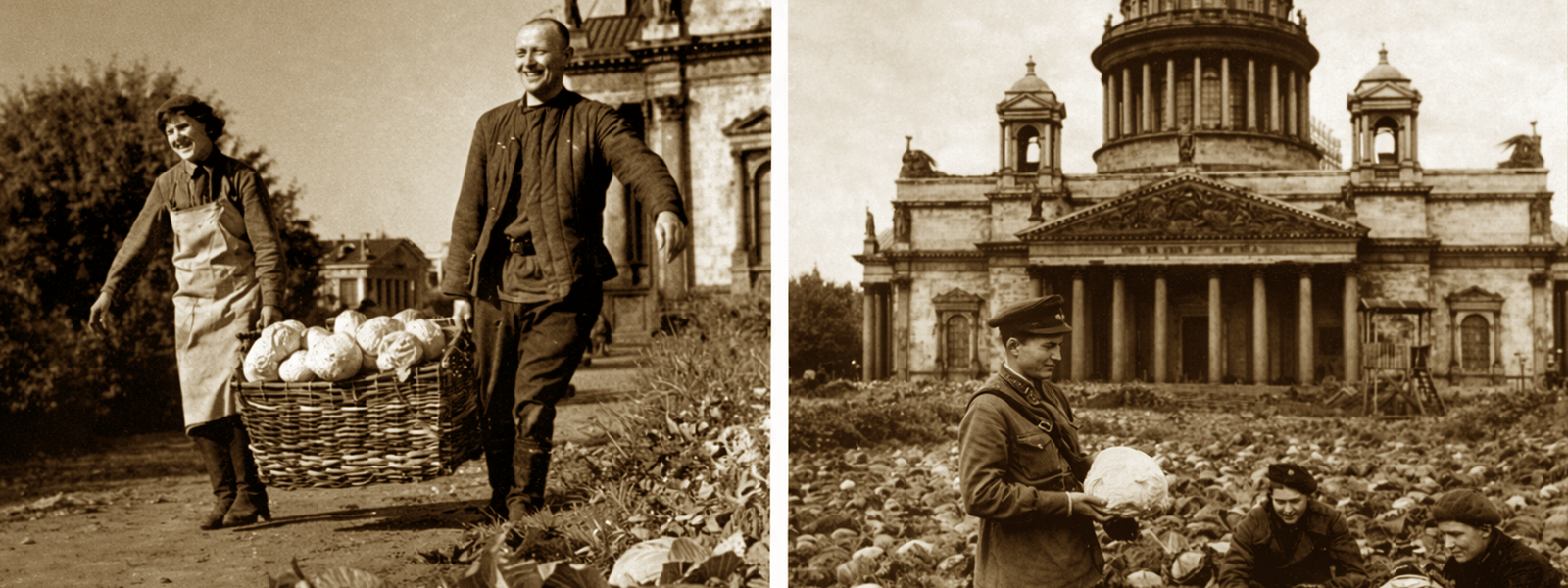
Imagine the city center, where instead of flowers in the flowerbeds people began planting cabbage, beets and potatoes. It sounds like some kind of absurdity, but it was an ordinary thing for besieged Leningrad. People turned squares usually used for parades and mass events, and park areas where townspeople had strolled before the war, into huge vegetable beds and planted them with vegetables to somehow cope with hunger. St. Isaac's Square was no exception; during the war it turned into one big cabbage field, giving a chance to somehow feed oneself and one's children.
These vegetable gardens were tended by ordinary residents who had not been evacuated: mostly women, teenagers and the elderly. Many of them became gardeners against their will, coming to the beds right after a hard shift at the factory and working in snatches in their free time. Watering, weeding and harvesting took their last strength, of which people in those years had almost none left anyway. But everyone understood that these few beds were their only real chance to survive. It simply boggles the mind how people exhausted by hunger found the will to work the land when even an ordinary step was hard to take.
St. Isaac's Cathedral after the war
A special expert commission officially recognized the cathedral's condition as catastrophic. That is why, despite the extremely difficult economic situation in the country after the war, the state allocated significant funds for large-scale restoration work and the rescue of this symbol of courage and culture.
Today the memory of the feat of the employees who preserved the cathedral and its funds is immortalized in the memorial exhibition "So That We Remember...", located in its basements. This place immediately gives you goosebumps, because through installations, old photos and documents the history of that time literally comes alive. Here you can see with your own eyes the impossible conditions in which almost 100 people daily performed their quiet feat, saving from destruction thousands of masterpieces that we are used to seeing today in museum halls. The place preserves archival photos, journals, and personal stories of the caretakers. It seems that even in summer it is just as cold and damp here as during the Great Patriotic War.
Looking today at the peaceful square, it is hard to realize that these lawns once literally saved lives. Now people come here to take beautiful photos or have a picnic on the lawn with fresh pastries and coffee, but before, here, on the cabbage field, women, old people and children worked to somehow get food for themselves in the hardest years of the siege.
This story is not only about St. Isaac's Cathedral. This story is about the heroism of people during the siege, about courage and bravery, about help and compassion, about labor! Only by uniting did Leningraders manage to save priceless sculptures and paintings, camouflage the cathedral's dome, and plant a huge field of cabbage. And all in order to survive themselves and give that opportunity to their native city, Leningrad.
St. Isaac's Cathedral: answering questions
-
Where St. Isaac's Cathedral is located
St. Isaac's Cathedral is located in the center of St. Petersburg, on St. Isaac's Square, at the address: St. Isaac's Square, 4. Nearby are the Admiralty, the Bronze Horseman and Palace Square. -
St. Isaac's Cathedral how to get there
You can walk to St. Isaac's Cathedral in 10–12 minutes from the Admiralteyskaya metro station or in 15–20 minutes from the Sennaya Ploshchad, Sadovaya and Spasskaya stations. -
St. Isaac's Cathedral opening hours
From 10:00 to 18:00 (ticket offices from 10:00 to 17:30). Closed on Wednesday and January 1. -
St. Isaac's Cathedral architect
The chief architect of St. Isaac's Cathedral was Auguste de Montferrand – a French architect who devoted almost 40 years to the construction of the church. The cathedral was built in the style of late classicism (Empire style). -
St. Isaac's Cathedral inside
Inside St. Isaac's Cathedral you can see a unique interior with a dome about 100 meters high, mosaic and painted icons, columns of solid granite and malachite, bronze sculptures and bas-reliefs, the main iconostasis with a stained-glass window of Christ, as well as museum exhibitions dedicated to the history and construction of the cathedral; in addition, a climb to the colonnade with a panoramic view of St. Petersburg is open.
Tour of Blockade Leningrad
If you want to immerse yourself even more in the history of wartime St. Petersburg, Leningrad Tour has prepared an excursion for you.
Besides St. Isaac's Square you will visit the Piskaryovskoye Memorial Cemetery, dedicated to the memory of all Leningraders and defenders of the city, learn the story of Tanya Savicheva and the fate of the most terrible and tragic diary in history, as well as who now lives in her house, visit the Siege Church, which holds 8,000 named bricks in memory of those who died during the siege of Leningrad.

Tour of Blockade Leningrad
Go to the tour →








