


Author of materials about St. Petersburg, travel, excursions, and city routes.

A guide to St. Petersburg's architecture, the history of the Romanovs, and the suburban residences.
St. Petersburg is famous for its palaces, churches, and cathedrals. However, among them there is a unique building – the Mikhailovsky (Engineers') Castle – the only secular structure in Russia named after a saint – Archangel Michael, patron of the Romanov house. It is a true knightly citadel on the water, shrouded in legends and prophecies that still excite. They say that the ghost of Paul I still walks the walls of this castle. Lovers of secrets and mysticism definitely need to visit here.
History of the Mikhailovsky Castle: a fortress from a dream come true
According to one of the most famous legends, Paul I decided to build Mikhailovsky Castle because he feared palace coups and did not wish to remain in the Winter Palace. He sought to create an "impregnable palace-castle" that would become his official and protected residence for permanent living.
The choice of location was deeply personal: the emperor wanted to build his new home exactly where he was born – on the site of the old wooden palace of Elizabeth Petrovna. By the way, the construction also became the realization of his long-held dream, a project he had been contemplating for almost 20 years even before ascending the throne.
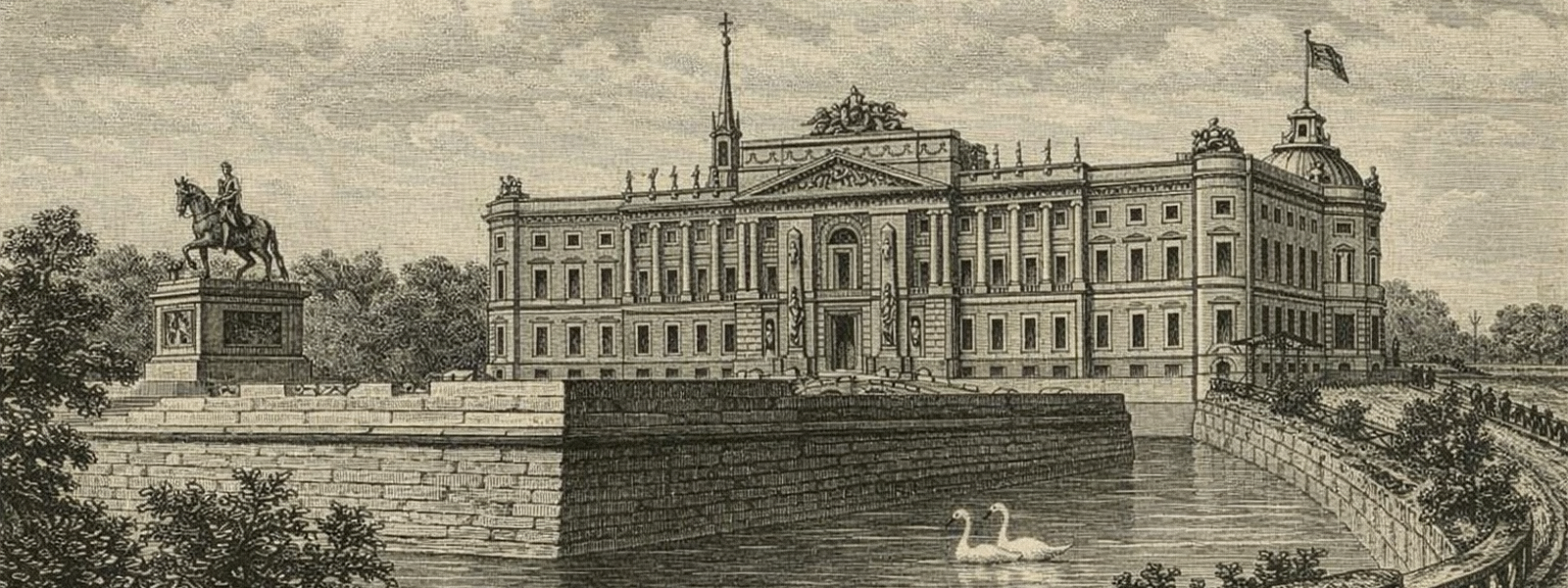
The castle was designed as an impregnable island: it was surrounded by the Moyka and Fontanka rivers, as well as specially dug canals – the Voskresensky and Tserkovny. One could only get inside through guarded drawbridges, which were protected by sentries and cannons. In front of the main entrance was Konyushennaya Square, surrounded by a water-filled moat, around which were bastions with guns.
Paul I was in such a hurry to move to what he considered a safe place that the castle was built in only 3.5 years. He moved into the building on February 1, 1801, when the walls were still damp and the finishing was not complete. Despite all the precautions taken, the emperor's fears came true: he was killed in his own bedroom by conspirators on the night of March 11–12, 1801.
In 1820, when the castle ceased to be an imperial residence, architect Carlo Rossi redesigned the surrounding area. During these works, the drawbridges were removed, and the canals surrounding the castle (the Voskresensky and Tserkovny) were filled in.
However, by the 300th anniversary of Saint Petersburg in 2003, the castle and its fortifications underwent large-scale restoration. The surviving underground fragments of the Voskresensky Canal and the Three-Span Bridge were reconstructed and opened.
Architecture: A Knightly Citadel on the Water
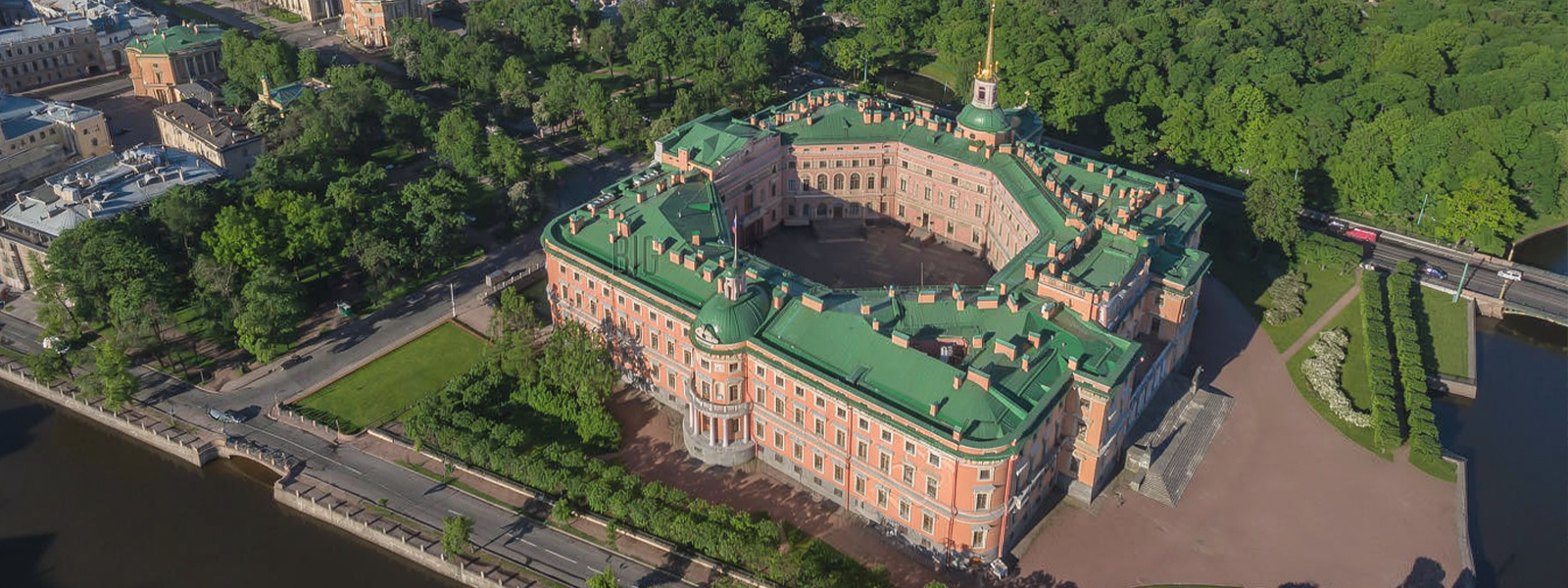
Mikhailovsky Castle is the largest architectural monument of the 18th century, shaped as a square with rounded corners and an octagonal inner courtyard. The building has 3 floors, including the piano nobile, where the state enfilades are located.
Construction was carried out in record time, for which materials were transferred from other construction sites in Petersburg. Marble, columns, and friezes were borrowed from St. Isaac's Cathedral, Tsarskoye Selo, and the unfinished palace in Pella. The building's foundation rests on a massive pile field of coniferous trunks.
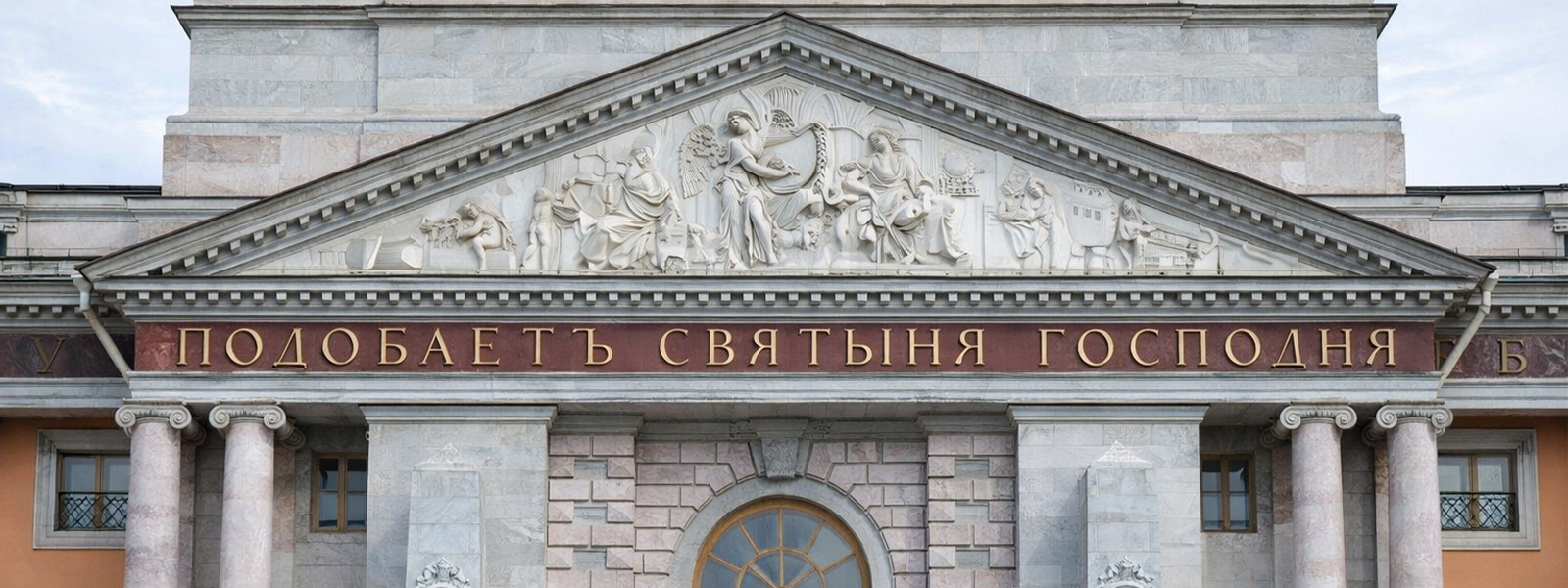
The architectural style of the castle combines elements of classicism and baroque, which is characteristic of the transitional period of the late 18th century and also refers to Paul I's affiliation with the Maltese Order. The Maltese Order, uniting military, religious, and charitable traditions and symbolizing the ideals of chivalry and Christian service. The southern facade is greeted by a triumphal arch and obelisks decorated with imperial monograms; 8 statues on the facade correspond to the 8 provinces of the Maltese Order. The northern facade, facing the Summer Garden opposite, looks like an open terrace with a wide staircase and colonnade. The gilded spire of the Church of Archangel Michael is crowned with a Maltese cross.
Interior Features: The Shine of Gold and the Cold of Marble
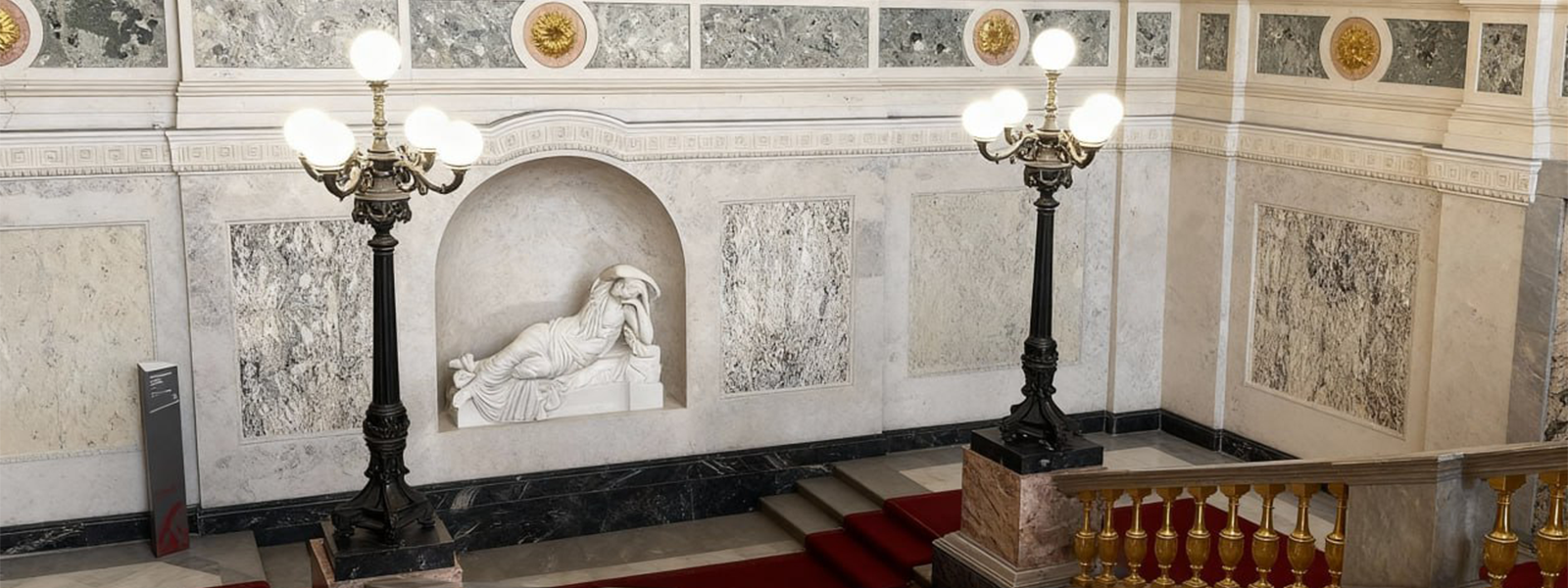
The interior of Mikhailovsky Castle was created by the best masters of that era: Vincenzo Brenna and Giacomo Quarenghi. The interior decoration used natural Siberian marble, artificial marble, porphyry (for fireplaces and vases), lapis lazuli, jasper, and gilded bronze. The floors were laid with parquet taken from the Tauride Palace.
The grand staircase greets guests with the symbolic statue of the Dying Cleopatra. It serves as an allegorical symbol of the sunset and the end of Catherine II's long reign. Within the castle's space, Cleopatra is contrasted with the sculptures of Prudence and Justice located in the side niches, which personify the beginning of a new era and the rule of her son, Paul I.
Also in the castle you can see: the common dining hall, the place where on March 11, 1801, the emperor had his last supper before the tragic night, the throne halls, of which there are as many as five in the castle, including the Throne Room of Empress Maria Feodorovna, and the Hall of Antiquities, where original sculptures from the Summer Garden are now displayed
The knightly spirit of the residence is reflected in the Maltese symbolism, including images of coats of arms with the order's cross and the St. George Hall, which served as a guardhouse.
Owners and fates: From emperors to engineers
The first and main owner, Paul I, lived in his "safe" castle for just over a month. He moved into an unfinished building where the walls were still weeping with damp and the plaster had not dried. The emperor's tragic death in his own bedroom at the hands of conspirators forever changed the fate of the castle.
After Paul, the Romanovs left this place. In 1819, the castle was occupied by the Main Engineering School, giving the building its second name – the Engineers' Castle. Within its walls studied Fyodor Dostoevsky, whose name today is inextricably linked with the atmosphere of St. Petersburg.
Legends hovering around the Mikhailovsky Castle
St. Michael's Castle is inextricably linked with mysticism. The most famous legend concerns the inscription on the southern facade: "THY HOUSE SHALL BE HOLY UNTO THE LORD, FOR LENGTH OF DAYS." A St. Petersburg holy fool predicted to Paul that he would live as many years as there are letters in this saying. The text has 47 letters, and it was in his 47th year of life that the emperor was killed in his bedroom, having spent only 40 days in the new residence.
They say that the ghost of "poor Paul" with a candle in his hands is still seen in the windows of the 2nd floor from the side of Sadovaya Street.
Another legend says that the pinkish-orange shade of the facades was chosen to match the glove of Anna Lopukhina, the emperor's favorite. Restorers confirmed this version by finding fragments of the original paint under layers of later plaster.
The third legend says that to a sentry soldier standing on night watch at the old Summer Palace, a youth surrounded by radiance appeared, who ordered him to convey to the emperor the will – to erect on this very spot a "temple and house in the name of Archangel Michael". Upon learning of the incident, Paul I ordered the castle to be built and named it St. Michael's.
What to see in the Mikhailovsky Castle
Overall, this is perhaps the only place in St. Petersburg where the knightly spirit is truly felt. The air here is cool, stony, with a slight smell of damp and old walls. In feeling – like tart wine or dark bread: not for everyone, but it grips you. It's good to come here as a couple, with family, or alone – the castle gives a rare sense of a separate world, which no longer exists anywhere else in the city.
Currently, St. Michael's Castle is a branch of the Russian Museum. Here there are permanent exhibitions dedicated to the history of the building, a portrait gallery, and ancient themes in art. It is also worth looking into the castle courtyard. In front of the southern facade stands an equestrian statue of Peter I with the inscription "To Great-Grandfather from Great-Grandson", and in the inner courtyard – a modern monument to Paul I.
Mikhailovsky Castle: answering your questions
-
Where is St. Michael's Castle located?
The castle is located in the center of St. Petersburg at 2 Sadovaya St., and the main entrance to the museum is from the side of Zamkovaya Street near the monument to Peter I. The most convenient way to get there is on foot from the metro stations "Gostiny Dvor" or "Nevsky Prospekt", or by bus and trolleybus to the nearest stops. -
How to get to St. Michael's Castle?
The most convenient way to get there is on foot from the metro stations "Gostiny Dvor" or "Nevsky Prospekt", or by bus and trolleybus to the nearest stops. -
How long was the castle considered the Engineers' Castle?
The name "Engineers'" was attached to the castle from 1819, when the Main Engineering School was housed in it. Military engineering educational institutions occupied the building for a century and a half, until 1960, when the military department began gradually vacating the premises. -
What is best to see near St. Michael's Castle after the tour?
Right behind the northern facade of the castle is the Summer Garden, and in front of the entrance and in the inner courtyard there are monuments to Peter I and Paul I. Also within walking distance are other branches of the Russian Museum – the Mikhailovsky Palace and the Benois Wing. -
Can you visit the Mikhailovsky Castle with small children?
Yes, you can. For preschool children (under 7 years old), admission to the museum is free, and for schoolchildren from 7 to 14 years old there is a discounted ticket price. Tour programs are designed for different ages, which allows guides to tell the history of the castle in an interesting and informative way for both adults and children. -
Mikhailovsky Castle opening hours?
• Monday, Wednesday, Thursday, Friday, Saturday and Sunday: from 10:00 to 19:00.
• Tuesday: closed. Please note that the ticket offices close an hour earlier, at 18:00. In addition, entry to the exhibitions is organized in sessions every 30 minutes; ticket sales and visitor admission stop 1 hour 30 minutes before the museum closes
Tour of Mikhailovsky Castle
The Mikhailovsky Castle is the soul of the “other,” anxious and mysterious Petersburg. You can go there with our tour, to feel the course of history and, perhaps, personally meet the shadow of the last knight on the Russian throne.
On this tour you will also see the main architectural landmarks of the historic center: the majestic St. Isaac's Cathedral and the elegant Smolny Cathedral, admire palaces, bridges and monuments, learn how Petersburg was formed, and about the great figures whose destinies are inextricably linked with the Northern Capital.

Tour of Mikhailovsky Castle
Go to the tour →








