


Writes about St. Petersburg, its history, sights, museums and routes.
Museum guide to art, culture and St. Petersburg of the 18th–19th centuries.
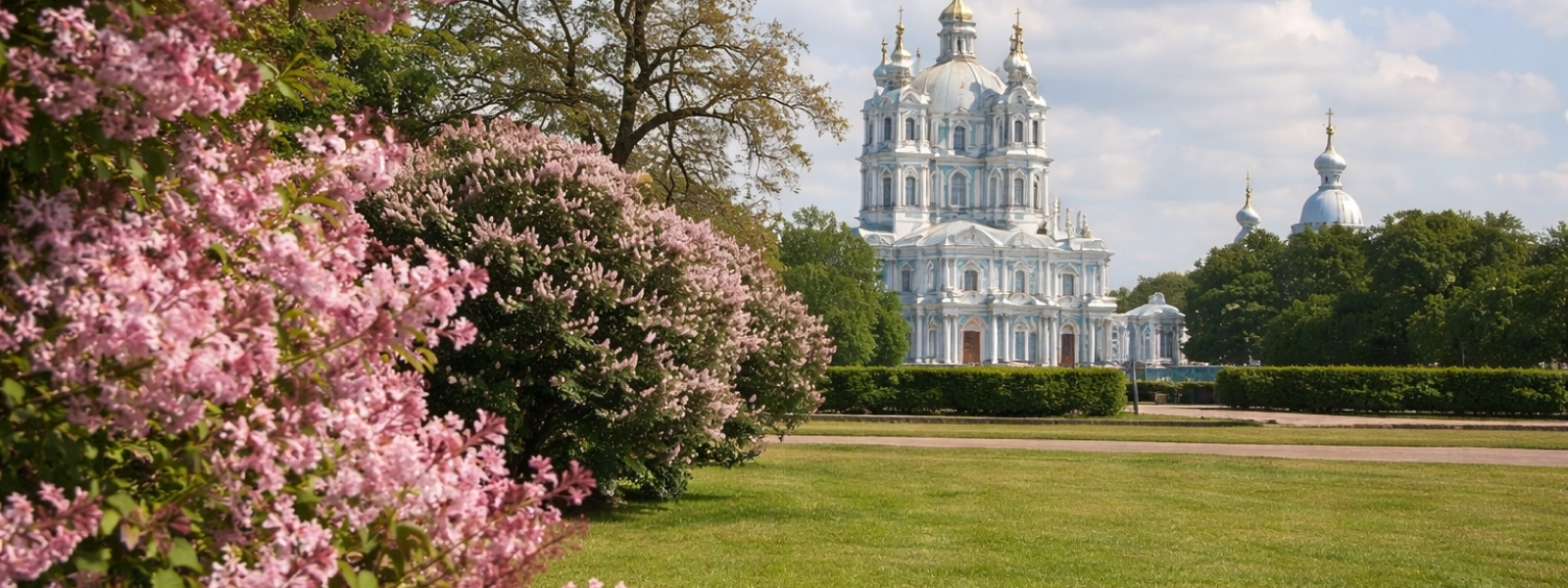
The Resurrection Smolny Cathedral is rightly recognized as a pearl of St. Petersburg Baroque. It rises by the Neva, drawing the eye with its azure facade and scattering of golden stars, which look especially beautiful against the sky.
The history of its construction is full of mysterious events. A visit to this place gives a chance to see the past with your own eyes and admire the panorama of the city from a bird's-eye view.
The cathedral embodies imperial scale, spiritual power and the mysterious aura of urban legends. For centuries it has held the status of the church of all educational institutions of Russia, protecting students and inspiring seekers of truth. It is worth visiting Smolny for the high observation deck in the historic center, rare optical illusions and the sense of the might of ancient masonry.
From the Smolny Yard to Smolny Cathedral
The history of this place began long before the construction of stone walls. Before the founding of St. Petersburg, the ancient Novgorod village of Spasovshchina (or Spasskoye) was located here. In the 17th century, the Swedes turned it into their fort Sabina, but Peter I returned the lands to Russia and founded the Smolny Yard here, where tar and pitch were boiled for the needs of the young fleet. This is where the name “Smolny” comes from – pitch.
Also on this site stood the “Smolny House” – a palace where the childhood and youth of Empress Elizabeth Petrovna were spent. Tired of court intrigues, she made a vow to build a majestic monastery here in order to end her days in silence and peace as its abbess.
Rastrelli's architectural challenge
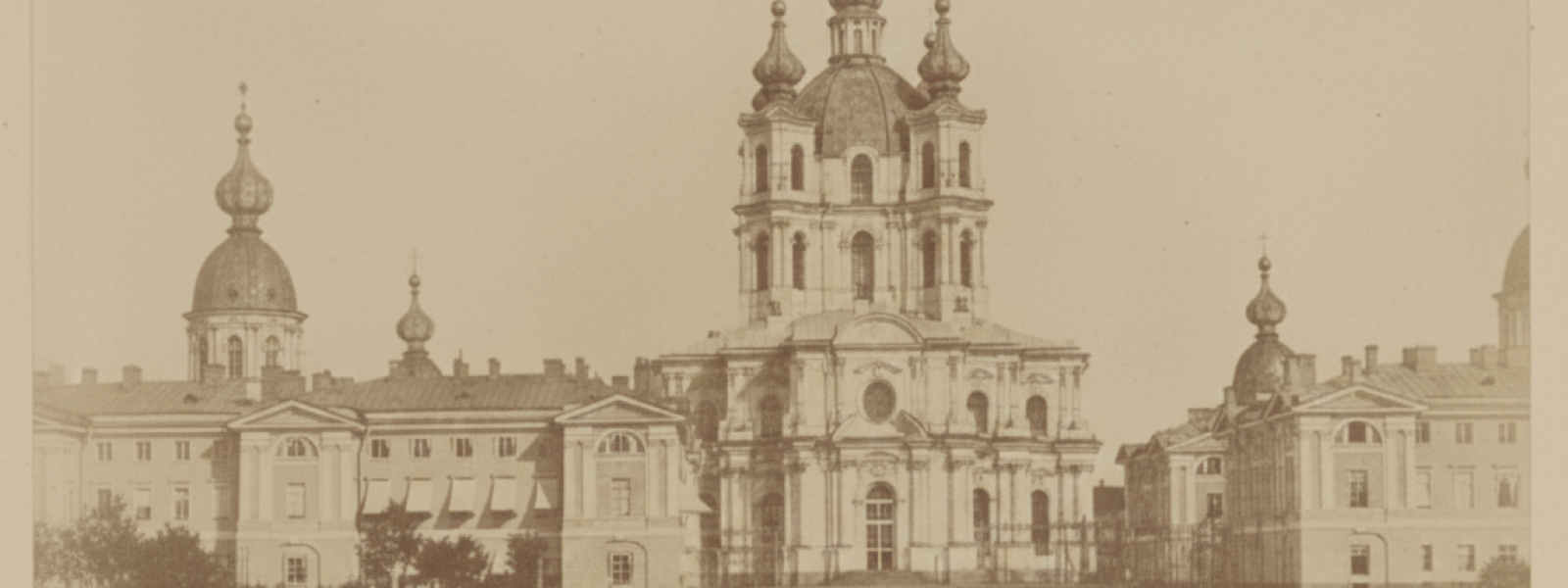
Francesco Bartolomeo Rastrelli was invited to realize the “royal venture.”
To test the building, a huge wooden model was created. It was so large-scale that to assemble it in a house on Bolshaya Morskaya Street, walls in four rooms had to be demolished.
Elizabeth demanded that the cathedral have five domes, following the model of the Assumption Cathedral in Moscow, which Rastrelli brilliantly embodied in the style of Elizabethan Baroque.
The ceremonial foundation was laid on October 30, 1748. Every day, up to 2,000 soldiers and 1,500 craftsmen worked on the construction site, receiving three kopecks a day.
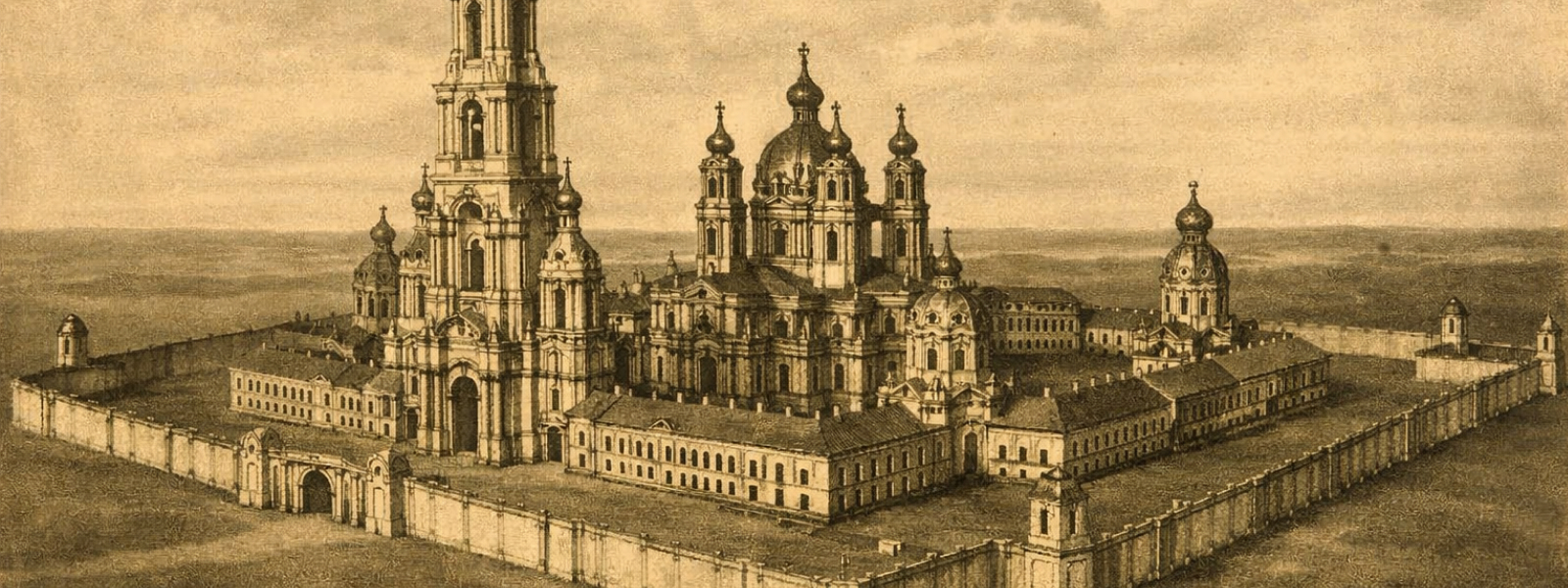
The cathedral was built over a record 87 years. Due to the 7th war, funding stopped, and construction stalled for almost 70 years. Only under Nicholas I did the work resume under the leadership of Vasily Stasov, who completed the decoration in the style of restrained classicism. As a result, the cathedral was consecrated only in 1835.
Historical and cultural significance
In 1835, Nicholas I granted the church the status of Cathedral of All Educational Institutions in memory of his mother, Empress Maria Feodorovna.
The names of all educational institutions of the Department of Empress Maria were inscribed on the walls of the cathedral in gold letters.
Every year on July 22, the feast day of Saint Mary Magdalene, thousands of students from the city gathered here for solemn prayer services – a special service in the Orthodox Church during which believers ask God and the saints for help in various circumstances of their lives and thank the Lord for His blessings.
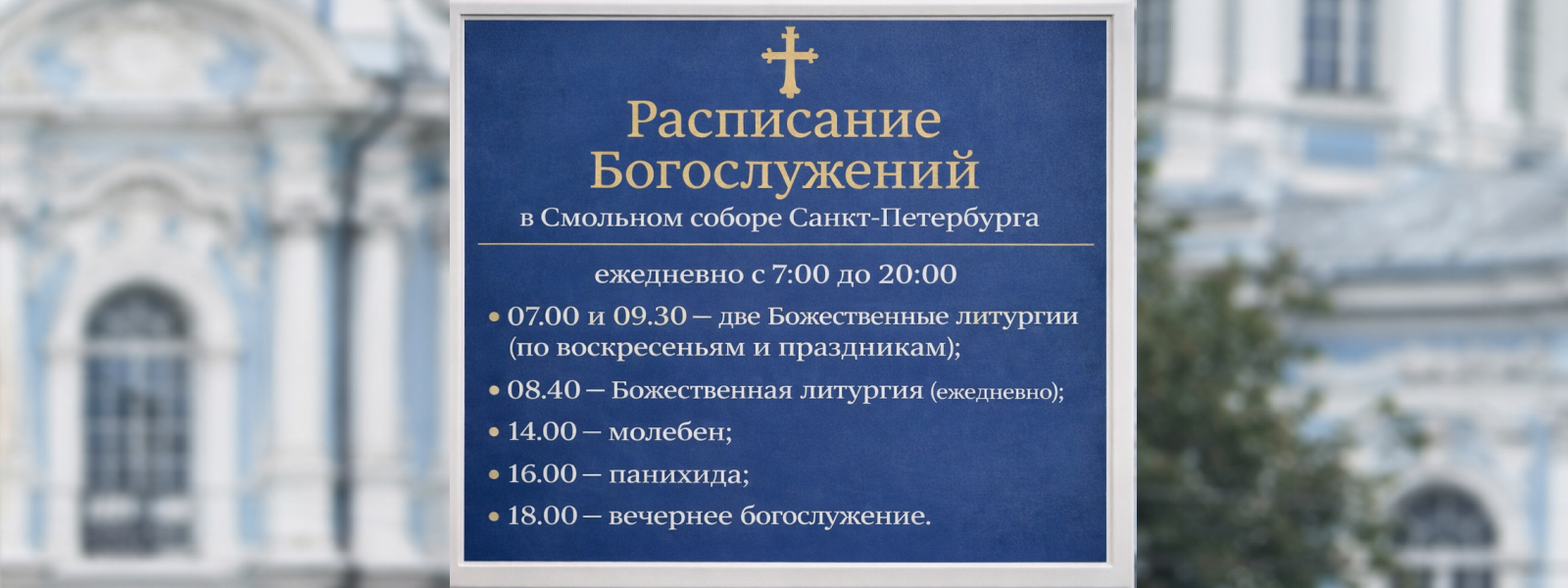
Today, the cathedral is home to the educational society for girls aged 4 to 12 called 'School of Smolyanki', the patriotic society for boys aged 5 to 10 called 'Page Corps', as well as the children's Sunday school of the Smolny Cathedral. Since 2015, the cathedral has been an active Orthodox church.
The inner grandeur of the interior
Stepping under the vaults of the Smolny Cathedral, you instantly find yourself in another dimension. Unlike the lavish Baroque facade, the interior, completed by Vasily Stasov, is designed in the style of restrained classicism. The vast space is flooded with light, creating the feeling of being on the set of a grand historical film.
Color palette and details
The walls of the cathedral are plastered and painted white, while the massive columns and the bases of the pylons are faced with white artificial marble.
Against the white walls, the gilded elements of the icons and the elegant carved icon cases shine brightly. If you raise your eyes to the dome, you can see the 'dome sky', which was conceived as azure with golden stars.
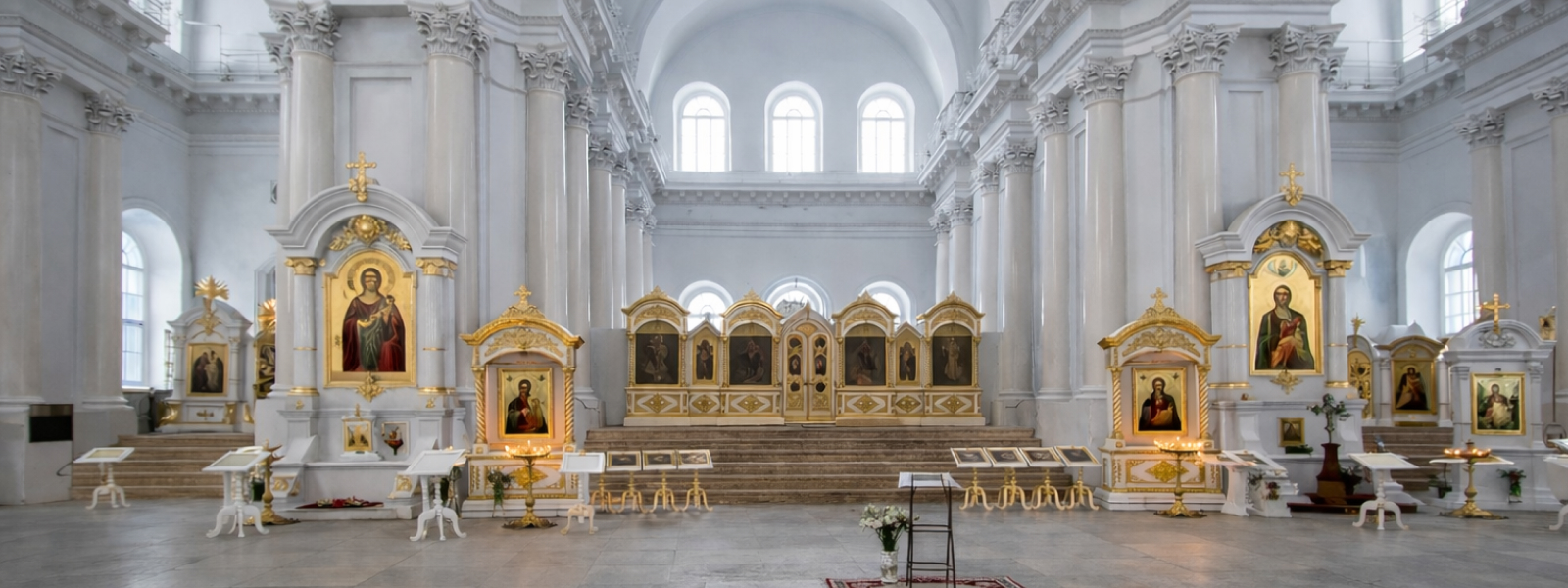
The only surviving original decoration is a copy of Alexey Venetsianov's painting 'The Presentation of the Mother of God' (the original is in the Russian Museum). Here you can also see a unique relic of the 18th century – the key to the western gates of the cathedral.
The cathedral has unique acoustics, thanks to which it was used for a long time as a concert hall for classical music. The sounds are reflected many times from the high vaults, creating a majestic echo.
As you ascend the bell tower, the atmosphere changes. In the old attic rooms there is a coolness and a smell of dampness characteristic of ancient stone buildings, which transports you to the atmosphere of a medieval castle.
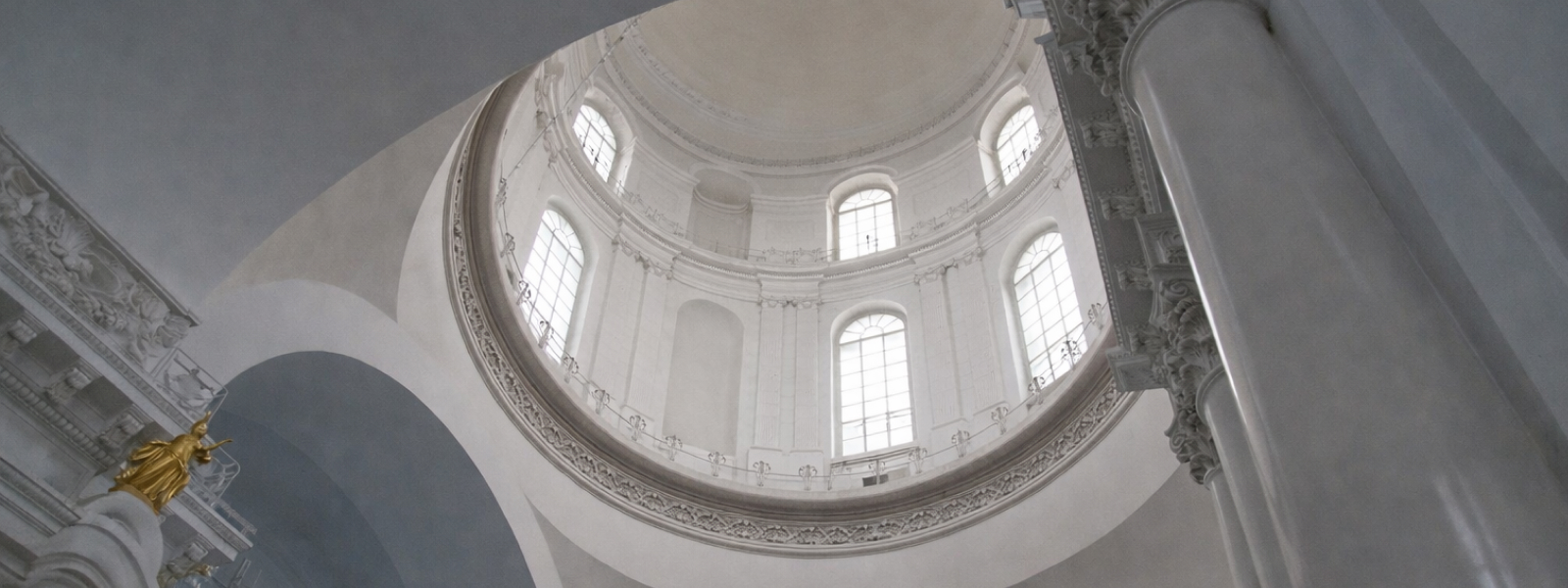
Observation deck of the Smolny Cathedral
The path to the highest observation deck in St. Petersburg (50 meters) is a separate adventure that takes your breath away. You will have to overcome 278 steps, and this climb will not be boring:
- First you walk along ordinary front staircases.
- Then you find yourself in a gloomy and authentic attic room, where the spirit of antiquity breaks through the massive wooden beams.
- The final spurt is a narrow stone spiral staircase, typical of ancient towers.
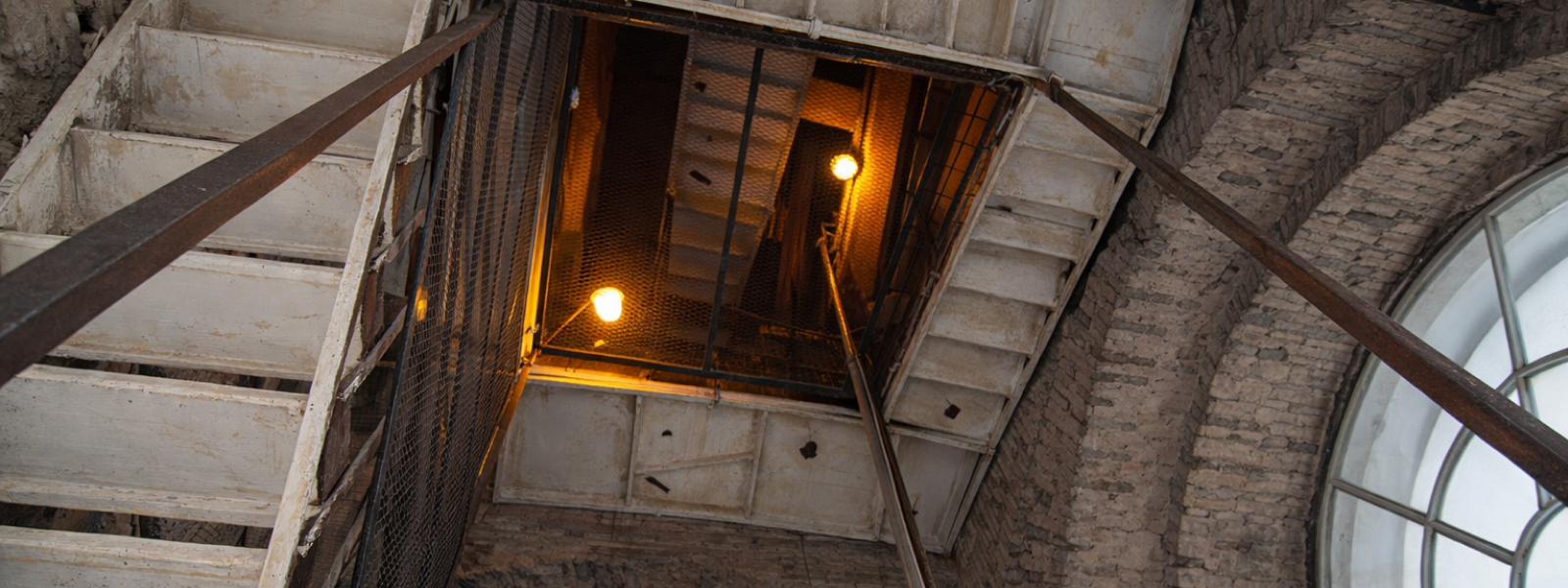
What unfolds before your eyes?
A breathtaking panorama opens up before you. Through binoculars you can make out:
- The graceful bend of the Neva and the futuristic Lakhta Center.
- The Bolsheokhtinsky Bridge and Rastrelli Square.
- The Smolny Institute building (the governor's residence) and the Alexander Nevsky Church.
- Even the dome of St. Isaac's Cathedral is visible on the horizon as a reminder of the grandeur of the imperial capital.
At the top, the piercing St. Petersburg wind greets you, humming in the bell towers. This place is perfect for feeling above the city, grasping its scale, and seeing how the Smolny Cathedral truly dominates the entire eastern part of the historic center.
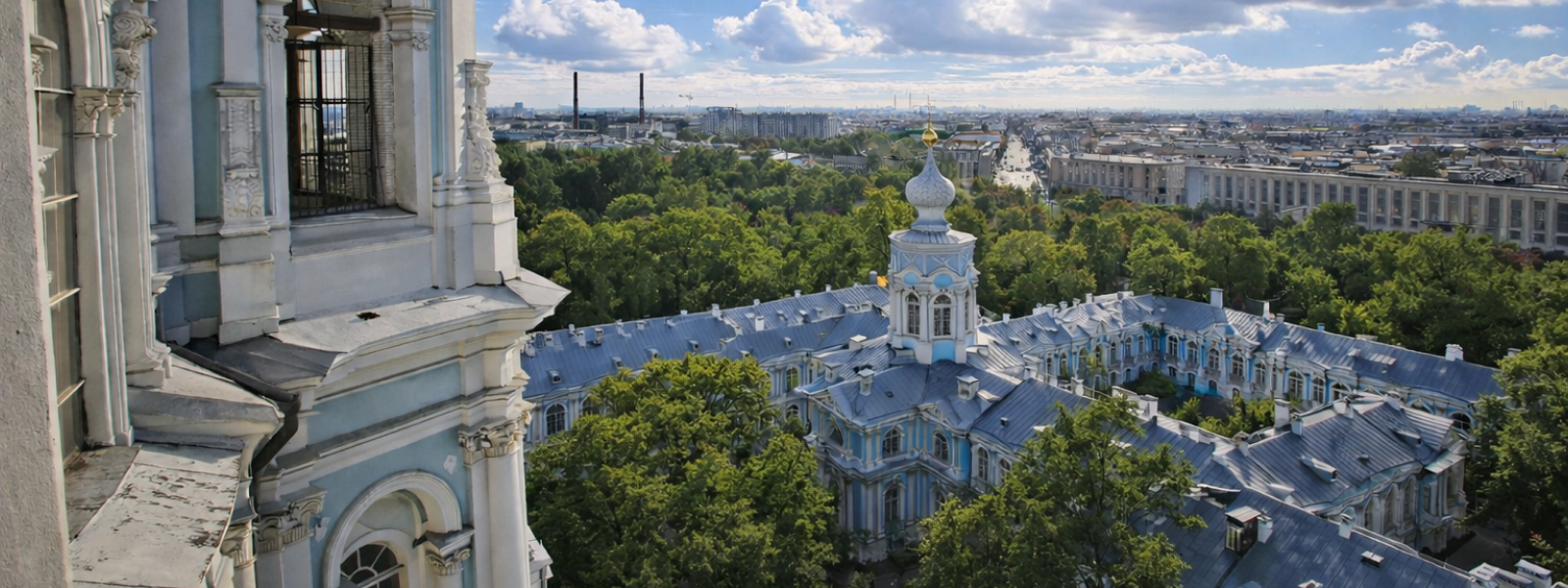
The road to Smolny Cathedral
The most convenient way to reach Smolny Cathedral is from the Chernyshevskaya metro station – the walk takes about 25–30 minutes. The advantage of this route is that it passes through the picturesque Tavrichesky Garden, where you can take a pleasant stop halfway, enjoy the scenery, and make use of the park's amenities.
For those who want to save time, buses No. 22, 74, 105, and other routes run from the metro and will get you there in 10 minutes.
Right by the walls of the cathedral lies the Smolny Cathedral Garden, where in historic times the pupils of the Institute for Noble Maidens strolled under the supervision of their governesses. Today this garden, together with the adjacent Kikiny Chambers square, serves as a cozy space for relaxation, offering tourists the best angles for photos against the backdrop of the majestic ensemble.
Myths and legends of Smolny Cathedral
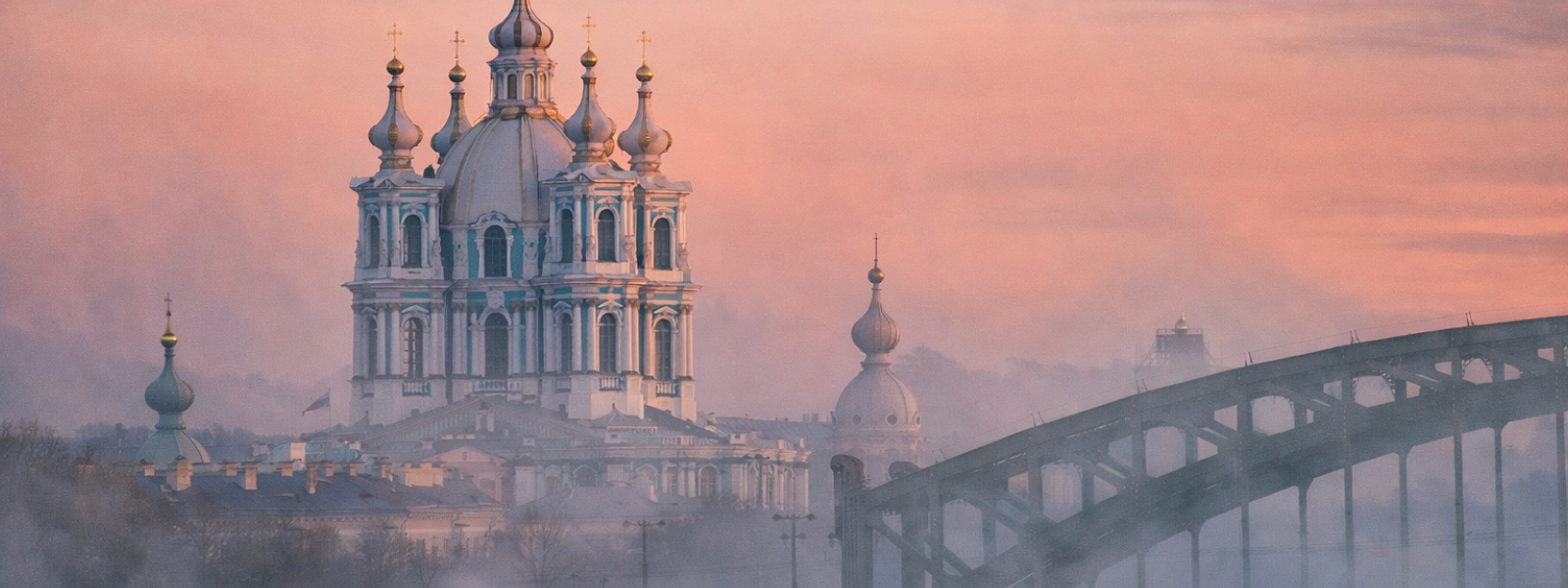
Smolny Cathedral is shrouded in the fog of mysticism no less than its domes are in St. Petersburg fog. The site was initially considered "unholy" – it was said that traces of the devil's hooves were found here, and for centuries people tried to "pray away" this land.
The legend of the curse and the suicide: The darkest myth claims that during construction, one of Rastrelli's assistants (or a contractor) took his own life right in the altar area. According to church canons, the cathedral could not be consecrated after such desecration for 100 years, which people considered the true reason for the prolonged construction.
The history of the cathedral is amazingly divided into three equal periods of 87 years each:
- From the ceremonial laying of the first stone in 1748 to the completion of works and the consecration of the cathedral in 1835, exactly 87 years passed.
- After the consecration in 1835, regular church services in the cathedral continued for another 87 years, until its closure by the Soviet authorities in 1922–1923.
- From its closure in 1922 until the resumption of regular services in 2009–2010, the cathedral again held a "non-church" status (used as a warehouse, museum, and concert hall) for another 87 years.
There are legends about secret underground passages leading toward Chernyshevsky Prospekt, and even about a secret metro branch connecting Smolny with the "Big House".
The ghosts of Smolny Cathedral
The pupils of the Institute for Noble Maidens ("Smolyanki") often saw in the corridors the silhouette of a woman in white, the so-called White Lady. It was said that this was the ghost of a nun or a victim of unhappy love.

There is a story about an apothecary-healer who caught pigeons on the cathedral's bell towers for his potions. He fell down, and many believed that he was pushed by the ghost of a suicide-builder.
Rastrelli planned to build a bell tower 140–170 meters high (taller than St. Peter and Paul Cathedral!). It was never erected, but old Petersburgers claimed that in heavy fog a ghostly silhouette of this majestic tower sometimes appears in the sky.
Tours around Saint Petersburg
The Smolny Cathedral is filled with secrets, legends and myths and shows St. Petersburg from a completely different side – more mysterious and intimate. But this is not the only place that helps you feel the scale and grandeur of the Northern Capital. To see the city as a whole and understand its character more deeply, it is most convenient to go on a tour and walk through the key points. It is convenient to continue getting acquainted with Petersburg on a sightseeing tour. Embankments, central squares and museums come together into a single picture of the city. The route includes St. Isaac's Cathedral, the Church of the Savior on Spilled Blood, panoramas of the Neva, the Hermitage and the main streets. This format helps you see Petersburg in three dimensions and connect individual impressions into a holistic feeling of the city.
Choose your travel format
The «Ленинград-Тур» website offers tours to St. Petersburg for 2, 3, 4 and 5 days with accommodation, a sightseeing program and a guide. We will help you choose a route for your dates and wishes.
- Programs for first trips and for those returning to St. Petersburg;
- Tours with suburbs, theaters and original routes;
- Options for families, couples, school and corporate groups.
The «Ленинград-Тур» team wishes you genuine enjoyment of St. Petersburg ❤️








